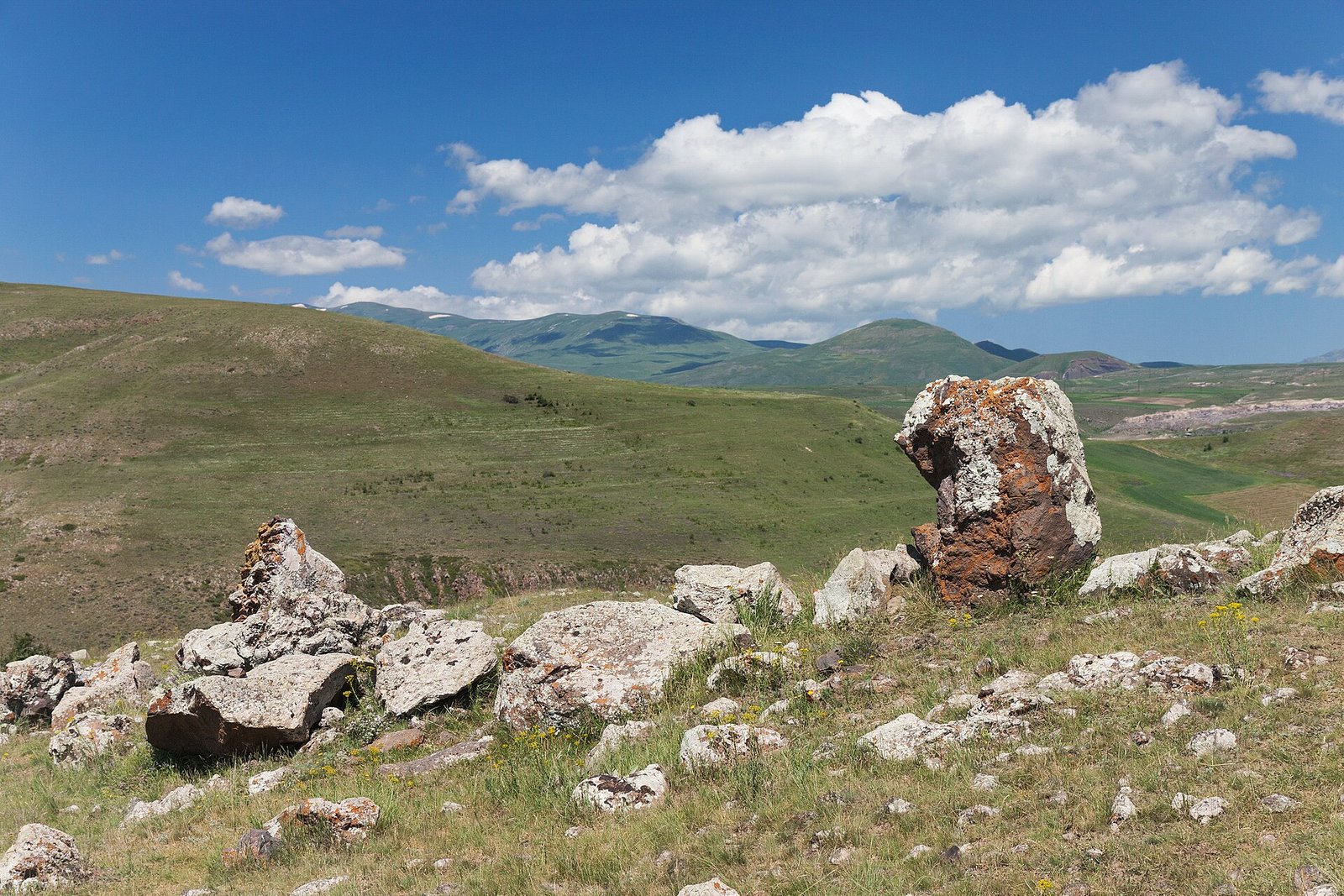
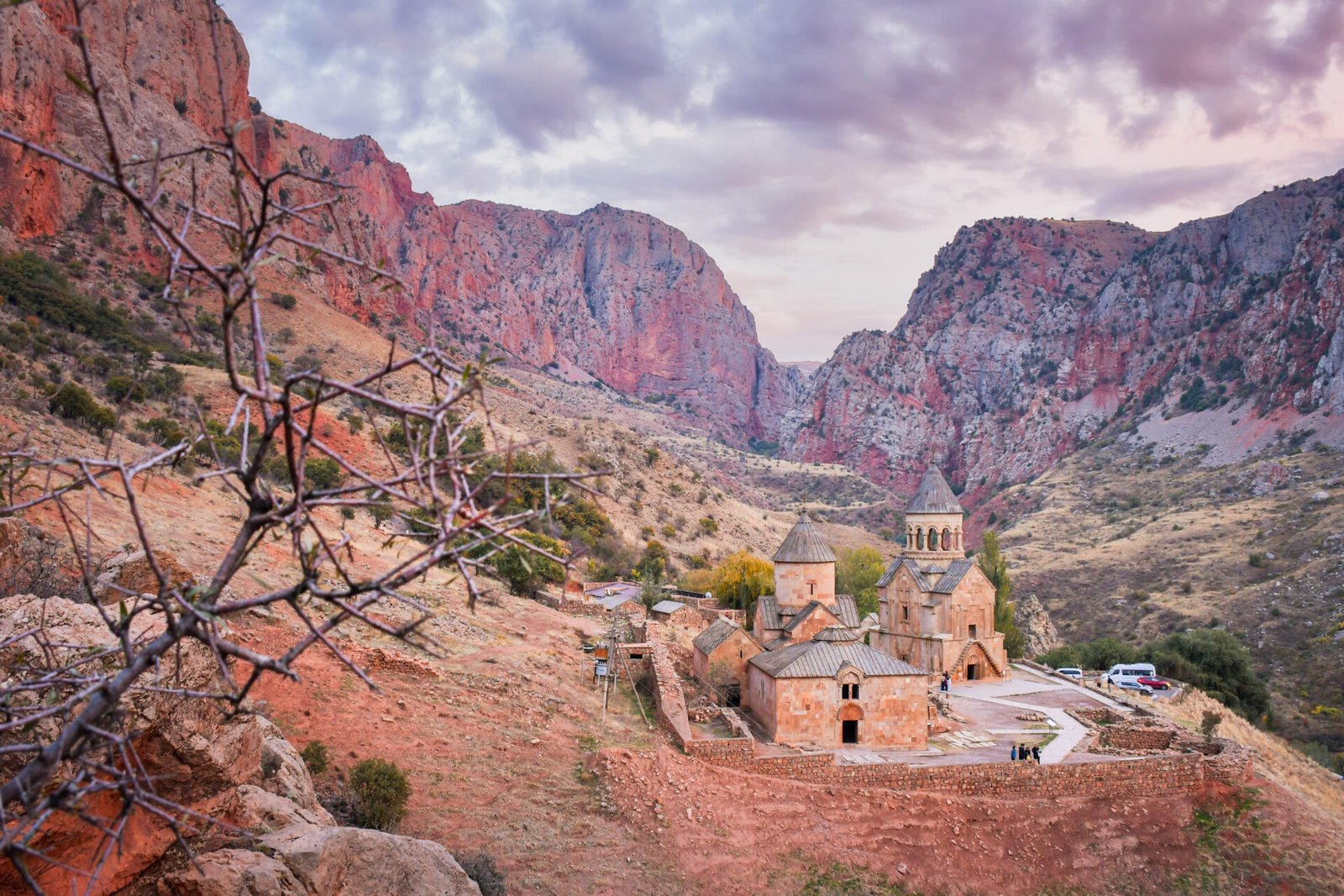
The best monasteries in Armenia are not gathered in one city. They sit at the end of gorges, on cliff ledges and above mountain passes, and reaching them is half the point. Tatev, Geghard, Noravank, Haghpat, Sanahin, Sevanavank, Khor Virap, Etchmiadzin, Goshavank and Amberd span seventeen centuries of building. Here is how to choose between them.
I have driven these roads for years with travellers who arrive expecting a handful of old churches and leave having understood something about how a small country kept its identity in stone. What follows is honest: which ones justify a long drive, which ones you can skip if time is short, and how they fit together into real itineraries.
| Monastery | Founded | Drive from Yerevan | Why go |
|---|---|---|---|
| Geghard | 4th c., present church 1215 | 45 min | Churches carved inside the rock, UNESCO |
| Garni and the Azat gorge | 1st century AD temple | 40 min | Roman temple, basalt columns |
| Khor Virap | 7th c., chapel 1662 | 45 min | Ararat straight ahead, the pit of St Gregory |
| Etchmiadzin | 301 to 303 AD | 30 min | Mother cathedral of the Armenian Church, UNESCO |
| Sevanavank | 874 AD | 1 h 15 | Lake Sevan from a headland at 1,900 m |
| Goshavank | 1188 onwards | 2 h | Forest setting, the finest carved khachkar in Armenia |
| Haghpat and Sanahin | 10th century | 3 h | Lori’s great medieval complexes, UNESCO 1996 |
| Noravank | 13th to 14th century | 2 h | Red cliffs, Momik’s two-storey church |
| Tatev | 895 to 906 AD | 4 h, or the cable car | Vorotan gorge, the longest reversible ropeway |
| Amberd | Church 1026, fortress older | 1 h 15 | Fortress and church at 2,300 m on Aragats |
Why Armenian monasteries feel different
If you have walked through Romanesque abbeys in Europe you will notice the change immediately. Armenian churches are small inside and enormous in presence. The builders worked in dark tuff and basalt, used a conical dome on a drum, and kept decoration to the doorway, the drum and the khachkars, the carved cross-stones that stand around every complex like a stone archive.
The other difference is that these are almost never ruins tended by a ticket office. Most are living churches. You will see a family lighting candles for a newborn, a priest chanting alone in a side chapel, a wedding party arriving in three cars. Nothing is staged. Armenia adopted Christianity as a state religion in 301 AD, and the buildings are the continuous physical record of that decision.
Entry is free at nearly all of them. That is not a small thing when you are planning a two-week trip. Your money goes on transport, not tickets.
Geghard: the monastery cut into the mountain
Geghard is the one I send people to first. The main church, Katoghike, was built in 1215 under the Zakarian princes, but the extraordinary parts are the chambers hollowed out of the solid cliff behind it, including a spring that still runs inside the rock and an upper chapel reached by a staircase carved from the same stone. The acoustics in the gavit are so good that local a cappella singers perform there most days, and a single held note fills the whole chamber.
The name comes from the spear, geghard, said to have pierced Christ’s side and to have been kept here for centuries. It now sits in the treasury at Etchmiadzin. The monastery and the Upper Azat Valley were inscribed by UNESCO in 2000. It is forty minutes from the city and pairs with Garni in a half day, which is why our Garni and Geghard half-day tour is the most booked thing we run. The full story is in our Garni and Geghard guide.
Tatev: the one worth a long day
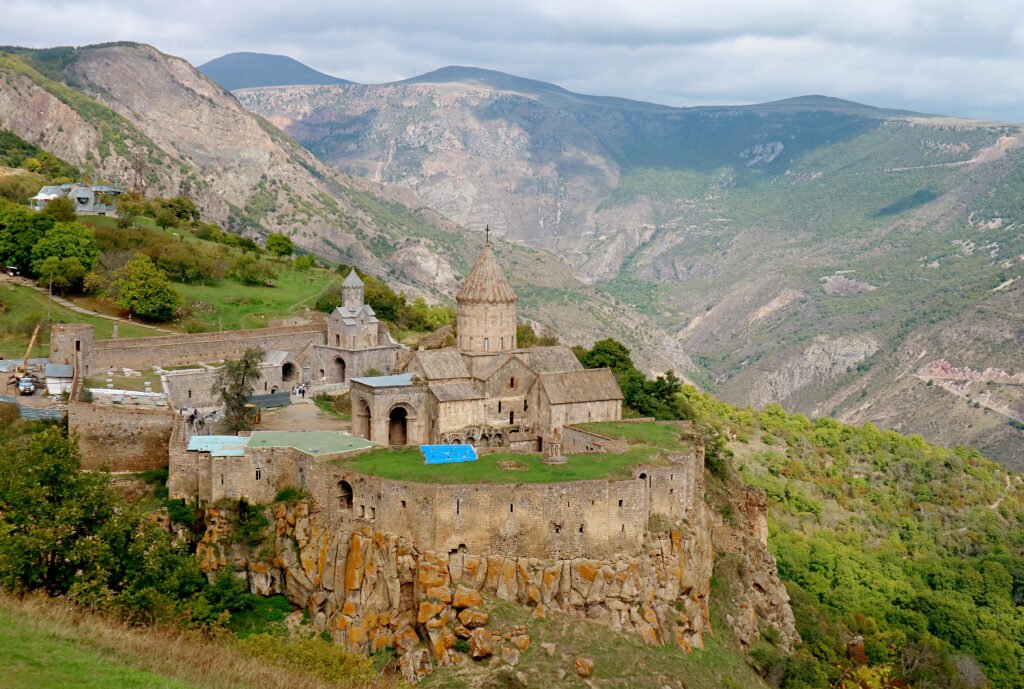
Tatev was founded between 895 and 906 AD and grew into a university with hundreds of scholars in the fourteenth century. It stands on a promontory above the Vorotan gorge in Syunik, in the far south, and for most of its life it was genuinely hard to reach. Since October 2010 the Wings of Tatev cable car has crossed the gorge in about twelve minutes over roughly 5.7 kilometres, recognised by Guinness as the longest reversible aerial tramway in the world.
A return ride costs roughly 15 to 22 euros in 2026, though the operator adjusts prices and seasons, so check before you set out. Tatev is about four hours from Yerevan by road, so treat it as an overnight or a very long day. Our Tatev and Wings of Tatev guide covers the timings, and the two-day Tatev trip is the relaxed way to do it.
Noravank: red cliffs and a staircase with no handrail
Noravank sits at the end of a narrow red-rock canyon in Vayots Dzor, and the approach road is as memorable as the arrival. The Surb Astvatsatsin church of 1339 is the work of Momik, who was architect, sculptor and manuscript illuminator in one person. Its upper chapel is reached by cantilevered stone steps projecting straight out of the facade, about twenty centimetres wide, with nothing to hold on to. People still climb them. Go in late afternoon, when the cliffs turn the colour of rust and the tuff of the church glows.
Noravank is an hour and a half to two hours from Yerevan and sits beside the Areni wine villages, which makes for one of the country’s best combinations of stone and glass. Read our Noravank and Areni wine region guide.
Khor Virap: Ararat at arm’s length
Khor Virap is not the most beautiful building on this list, and it does not need to be. It stands on a low hill on the Ararat plain with Mount Ararat, 5,137 metres and now inside Turkey, filling the entire sky behind it. This is where Gregory the Illuminator was held in a pit for thirteen years by King Trdat III before curing him and converting the kingdom. You can climb down a metal ladder into the pit itself, roughly six metres deep, if you are not claustrophobic.
Come early. By midday in summer the haze usually swallows the mountain completely. Our Khor Virap and Ararat guide explains the best photo windows and how to combine the site with Areni and Noravank in a single day.
Etchmiadzin: the mother church
Vagharshapat, usually called Etchmiadzin, is the seat of the Catholicos and holds what many consider the oldest cathedral in the world, founded between 301 and 303 AD. The cathedral came through a long structural restoration and is open again, and its treasury holds relics including the spear from Geghard and a fragment attributed to Noah’s ark. The nearby churches of Saint Hripsime, 618 AD, and Saint Gayane, 630 AD, are architecturally purer than the cathedral itself and belong to the same UNESCO inscription along with the ruins of Zvartnots. Thirty minutes from Yerevan, easy to fold into an airport transfer.
Haghpat and Sanahin: the Lori pair
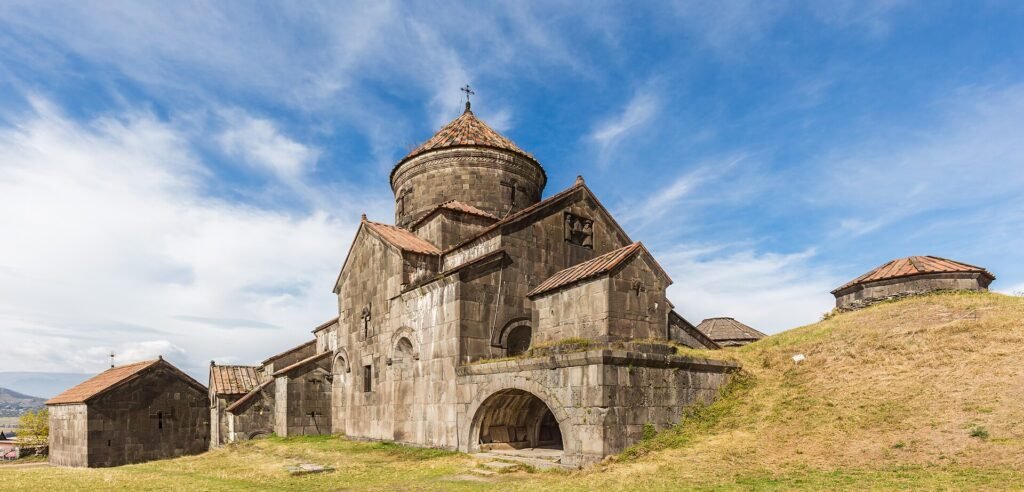
These two tenth-century complexes sit a few kilometres apart in the northern province of Lori, high above the Debed canyon, and were inscribed together by UNESCO in 1996. Haghpat was founded in 976 under Queen Khosrovanush. Sanahin’s name is usually translated as “this one is older than that one”, which tells you how the local rivalry went. Sanahin has a covered scriptorium and an academy hall; Haghpat has the better setting and a freestanding bell tower you can climb inside.
They are three hours north of Yerevan and belong in a northern Armenia itinerary rather than a day trip, ideally with a night in Dilijan or Alaverdi.
Sevanavank, Goshavank and Amberd
Sevanavank
Founded in 874 AD by Princess Mariam, daughter of King Ashot I, on what was then an island in Lake Sevan. Soviet-era water extraction dropped the lake by around twenty metres and turned the island into a peninsula, so today you walk up a staircase rather than arrive by boat. Two dark churches, enormous sky, water the colour of steel. Combine it with Dilijan on a day trip from Yerevan, or read the Lake Sevan guide.
Goshavank
In a village above Dilijan, founded from 1188 by the scholar and lawmaker Mkhitar Gosh, who wrote Armenia’s first law code here. The reason to come is a single object: the khachkar carved by the master Poghos in 1291, where the stone has been worked so finely that it reads as lace rather than rock. Photographers spend twenty minutes on that one slab.
Amberd
Not strictly a monastery but a fortress with the Vahramashen church of 1026 attached, standing at about 2,300 metres on the southern slope of Mount Aragats. The road is usually open from roughly late May to October and closed by snow the rest of the year. On a clear day you look down over the whole Ararat valley. It suits anyone interested in hiking in Armenia.
How to combine them without spending your holiday in a car
- Half day: Garni and Geghard. Four to five hours door to door.
- One full day, south: Khor Virap, an Areni winery, Noravank. About nine hours, and the best single day in the country.
- One full day, north-east: Sevanavank, Dilijan, Goshavank and Haghartsin. About nine hours.
- Two days, deep south: Yerevan to Tatev with a night in Goris or Tatev village, returning through Vayots Dzor.
- Two days, north: Haghpat, Sanahin, Odzun and Akhtala, sleeping in Dilijan or Alaverdi.
A week covers all ten comfortably, which is roughly how our classic seven-day tour is built.
We are a small Yerevan operator running trips for independent and solo travellers, in groups small enough to stop when the light is right. Have a look at our tours and tell us what you actually want to see.
Practical notes before you go
Dress. Covered shoulders and knees are polite. Nobody will stop you at the door for bare arms, but you are in a working church. Women do not need to cover their hair.
Shoes. Stone floors are worn smooth and often wet. The approach paths at Amberd, Noravank and Tatev are rough. Trainers are the minimum.
Photography. Fine almost everywhere, including inside. Do not photograph people at prayer, and put the camera down entirely during a baptism or a funeral.
Candles. Buy thin beeswax candles from the stand inside for a few hundred drams and light one. It is the normal thing to do and nobody will think you are performing.
Money. Bring small cash. The village stalls outside Geghard, Noravank and Sevanavank sell dried fruit, gata and sujukh, and none of them take cards.
When to visit
Late April to mid June is the best window. The gorges are green, the high passes to Amberd and Tatev are open, and the light is clean. September and October are almost as good, with harvest under way in the vineyards around Noravank and the Areni wine festival in early October. July and August are hot on the Ararat plain and hazy for mountain views, though Lori and Dilijan stay comfortable.
Winter is underrated if you accept the limits. Amberd is closed, the southern road to Tatev can shut for a day after heavy snow, but Geghard with snow on the cliffs and almost nobody there is something you will remember longer than any summer visit. See our notes on the best time to visit Armenia.
If you only pick three
Geghard for the carving, Noravank for the setting, Tatev for the scale. Add Khor Virap if the forecast promises a clear morning, because Ararat rising behind that small hill is the image most people carry home from Armenia.
Frequently asked questions
Which monastery in Armenia should I visit if I only have time for one?
Geghard is the most rewarding single visit, because the rock-cut churches carved directly into the cliff are unlike anything else in the country and it sits only 40 kilometres from Yerevan. It pairs naturally with Garni Temple in a half day. If you have a full day and want drama over convenience, choose Tatev instead and take the cable car across the Vorotan gorge.
Are Armenian monasteries free to enter?
Almost all of them are, including Geghard, Noravank, Tatev, Khor Virap, Haghpat and Sanahin. They are working churches rather than museums, so there is no ticket desk. Garni Temple is the main exception because it is a state-run archaeological site, and the Wings of Tatev cable car is a separate paid ride.
How many Armenian monasteries are UNESCO World Heritage Sites?
Three inscriptions cover monastic sites in Armenia. The Monasteries of Haghpat and Sanahin were listed in 1996, the Monastery of Geghard and the Upper Azat Valley in 2000, and the Cathedral and Churches of Echmiatsin with the archaeological site of Zvartnots also in 2000. Tatev and Noravank currently sit on the tentative list.
What should I wear when visiting a monastery in Armenia?
Armenian Apostolic churches are relaxed about dress compared with Greece or Italy. Covered shoulders and knees are polite, and women are not required to cover their hair, though a scarf is appreciated during a service. Sturdy shoes matter more than anything, because the stone floors and approach paths are uneven.