The best day trips from Yerevan take you from a first century pagan temple to a rock cut monastery, from the foot of Mount Ararat to a lake at 1,900 metres, all within about two hours of the city. Armenia is small, roughly the size of Belgium, and that is the practical gift of basing yourself in the capital.
| Ուղղություններ | Distance | Drive | Time needed |
|---|---|---|---|
| Garni and Geghard | 35 to 40 km east | 45 min | Half day |
| Khor Virap | 40 km south | 50 min | Half day alone, full day with Noravank |
| Echmiadzin and Zvartnots | 20 km west | 30 min | Half day |
| Lake Sevan and Dilijan | 65 and 105 km north | 1 to 2 hrs | Full day |
| Amberd and Aragats | 55 km northwest | 1 hr 15 | Full day, June to October |
| Areni and Noravank | 110 to 120 km southeast | 2 hrs | Full day |
How to think about day trips here
Armenia’s sights are spread along a handful of valleys radiating out from Yerevan, so almost every good day trip is an out and back along one road. The useful consequence: you can combine anything on the same road, and you should never try to combine two different directions in one day. People who attempt Sevan in the morning and Khor Virap in the afternoon spend five hours in a car and remember nothing.
Roads are generally good on the main corridors and rougher on the approach tracks. Distances look tiny on a map and take longer than you expect, partly because of mountain switchbacks and partly because you will stop for the views. Add 30 percent to whatever the map tells you.
If you have not yet worked out your time in the capital itself, our guide to things to do in Yerevan pairs naturally with this one.
1. Garni and Geghard: the essential half day
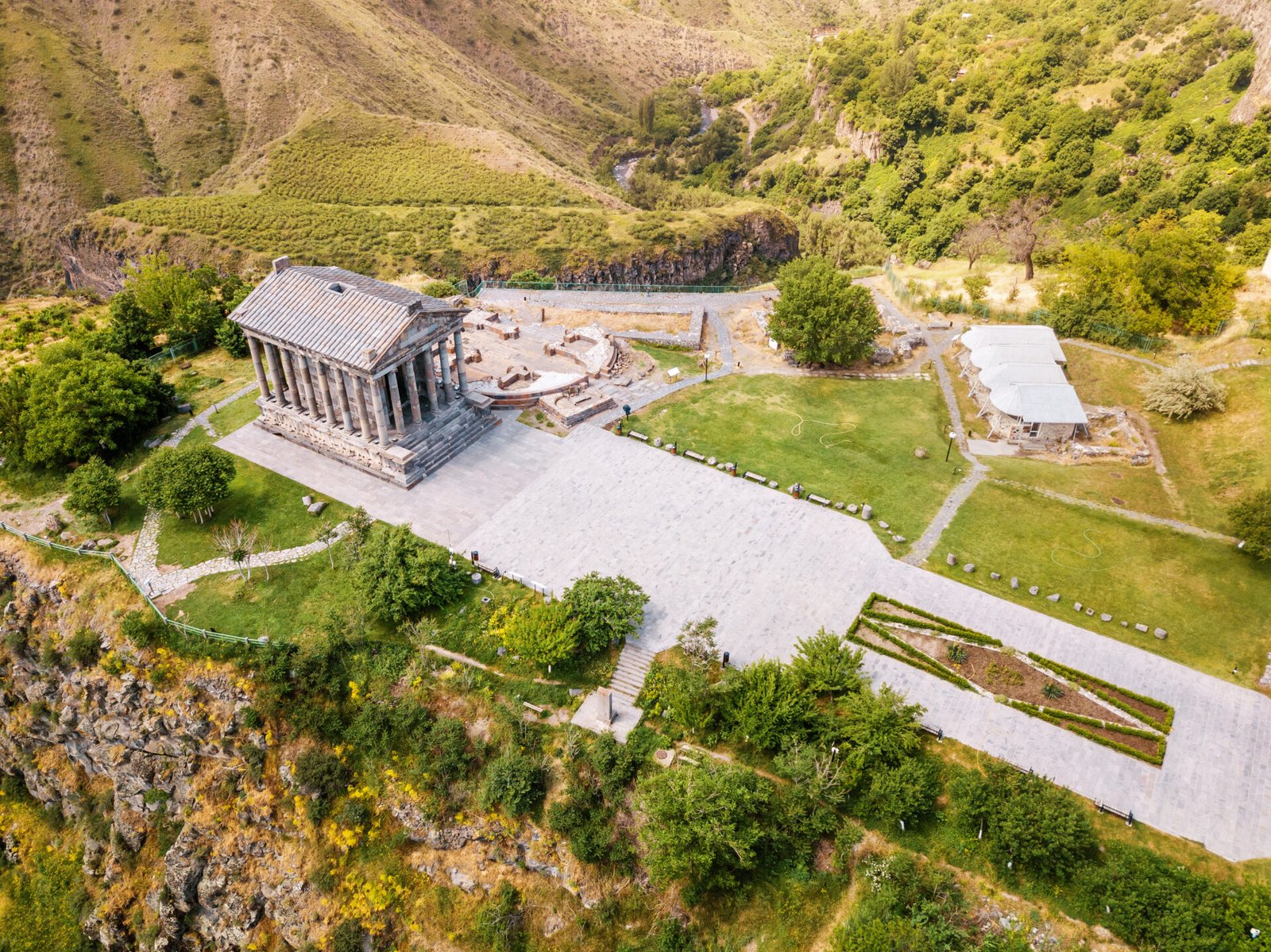
This is the trip almost everyone does first, and with reason. The Temple of Garni stands on a promontory above the Azat gorge, a Greco Roman colonnade built in the first century AD when Armenia was a kingdom balanced between Rome and Parthia. It is the only classical temple left standing in the former Soviet Union, rebuilt from its own fallen stones after an earthquake flattened it in 1679. The setting does most of the work: cliffs on three sides and, below, the basalt columns of the so called Symphony of Stones.
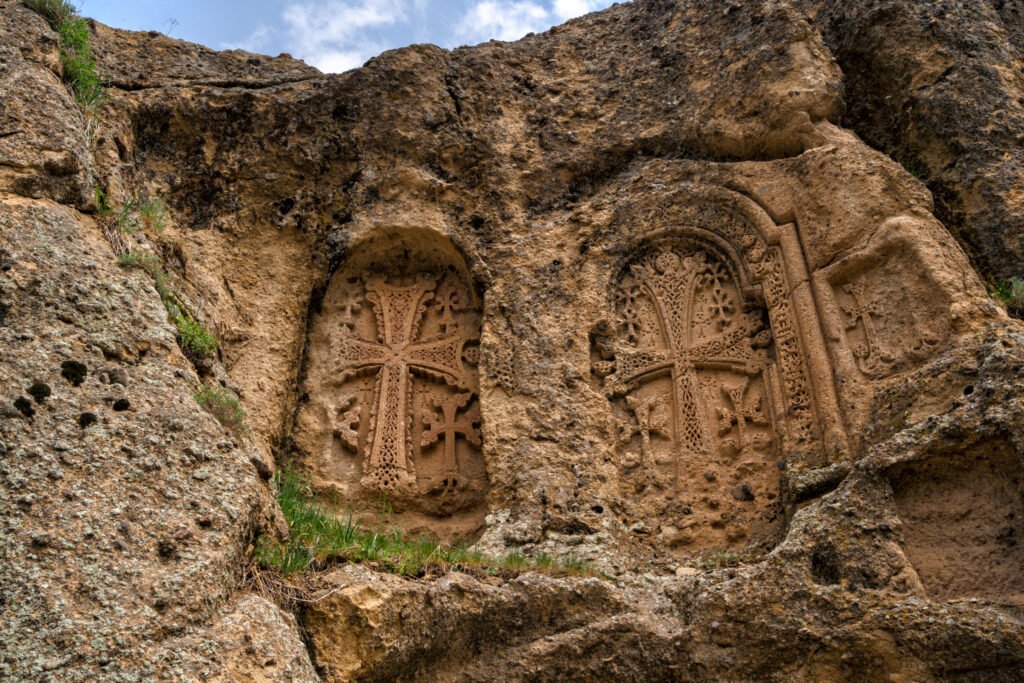
Ten kilometres further up the valley, Geghard is something else entirely. Half of the monastery is built, half is carved directly into the cliff, chambers hollowed out from the top down by masons who could not make a mistake. Go into the rear chapel and wait for a choir. Groups sing there because the acoustics turn four voices into forty, and it is the single most memorable thirty seconds most travellers have in Armenia.
Combine with lunch in Garni village, where families bake lavash in a tonir, the clay floor oven, and will let you slap the dough against the wall yourself. Full details in our Garni and Geghard guide.
2. Khor Virap: Ararat at arm’s length
Khor Virap sits on a low hill in the Ararat plain, right against the closed Turkish border, and the reason to go is what stands behind it. Mount Ararat, 5,137 metres, fills the entire southern sky from here. It is Armenia’s national symbol and has been in Turkey since 1921, which is a sentence that explains a great deal about the country.
The monastery itself is modest, but underneath it is the pit where, according to tradition, Gregory the Illuminator was imprisoned for thirteen years before converting King Trdat and making Armenia the first Christian state in 301. You can climb down into the pit on an iron ladder. It is narrow, dark and worth doing once.
Timing matters more here than anywhere. Ararat is usually clear at sunrise and hidden by haze from late morning through summer afternoons. Spring and autumn give the best odds. Read our Khor Virap and Ararat guide before you decide what time to leave.
Khor Virap alone is only half a day, so most people continue southeast to Noravank and Areni, which is the single best full day out of Yerevan.
3. Areni, Noravank and the wine country
An hour beyond Khor Virap the landscape turns red. Noravank sits at the end of a narrow gorge of rust coloured cliffs, a thirteenth century complex whose two storey church has a narrow external stair with no handrail leading to the upper chapel. The carvings by Momik, including an unusual depiction of God the Father, are among the finest in the country. Late afternoon light on those cliffs is the reason photographers plan their whole trip around this stop.
Nearby Areni is the centre of Armenian winemaking. The Areni-1 cave produced the world’s oldest known winery, about 6,100 years old, along with a leather shoe of similar age now in Yerevan’s History Museum. Small producers along the road offer tastings for a few euros. The local Areni Noir grape makes a light, high acid red that is nothing like a heavy Mediterranean wine and is much better with Armenian food. See our Noravank and Areni guide for the practicalities.
4. Lake Sevan and Dilijan: the northern loop
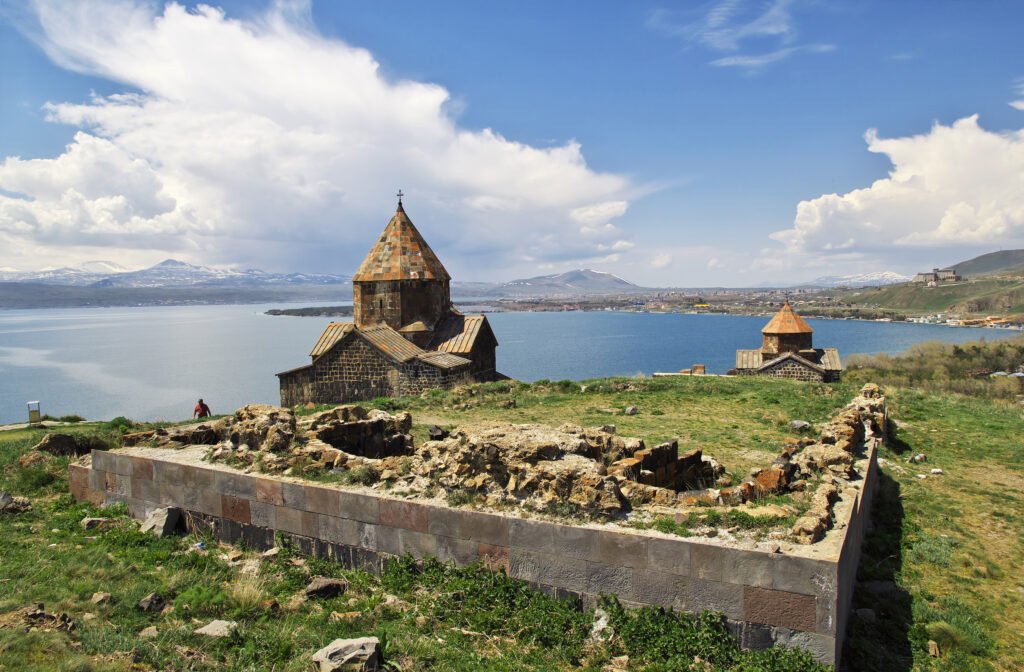
Sevan is one of the largest high altitude lakes in the world, sitting at 1,900 metres and covering about a sixth of Armenia’s surface. The water is an improbable turquoise on a sunny day and slate grey on a cloudy one. Sevanavank monastery occupies a peninsula on the northwest shore, reached by a staircase of about 200 steps that everybody complains about and everybody climbs.
Continue over the Sevan pass and the landscape changes completely. Dilijan is green, forested and humid, which Armenians find so unusual that they call it Little Switzerland. The restored Sharambeyan Street has craft workshops and wooden balconies, the Haghartsin monastery sits in the woods ten kilometres away, and the air is noticeably softer. Our Lake Sevan guide covers beaches, fish and swimming.
A word on swimming: the lake is properly cold until late July and only really pleasant in August. The crayfish and the ishkhan trout on the shore restaurants are excellent year round.
5. Echmiadzin and Zvartnots: the spiritual half day
Twenty kilometres west, Echmiadzin (officially Vagharshapat) is the seat of the Catholicos and the headquarters of the Armenian Apostolic Church, founded in 301 and arguably the oldest cathedral site in the world. The cathedral has been through long restoration work in recent years, so check its status before you go; the surrounding complex, the treasury and the churches of Saint Hripsime and Saint Gayane are open and remarkable in their own right.
On the way back, stop at Zvartnots, the ruined seventh century circular cathedral that collapsed in an earthquake around the year 930. Only the base and a ring of columns survive, but the scale of the thing, and the fact that the Armenians were building a three tier rotunda 1,300 years ago, lands hard. Both sites are UNESCO listed.
This pairs well with a morning at Khor Virap for a long but manageable single day.
6. Amberd and Mount Aragats: the alpine one
Amberd is a seventh century fortress at 2,300 metres on the southern slope of Mount Aragats, Armenia’s highest mountain. The approach road climbs through alpine meadows and, in June, fields of wildflowers. The castle and its small church stand on a spur above a confluence of two gorges, with nothing else in sight.
Higher up the same road is Lake Kari at 3,200 metres, the starting point for the walk to Aragats’s southern summit. The road is closed by snow from roughly November to late May, so this is a June to October trip only. Take a jacket regardless of what the Yerevan forecast says; it is routinely 15 degrees colder up there.
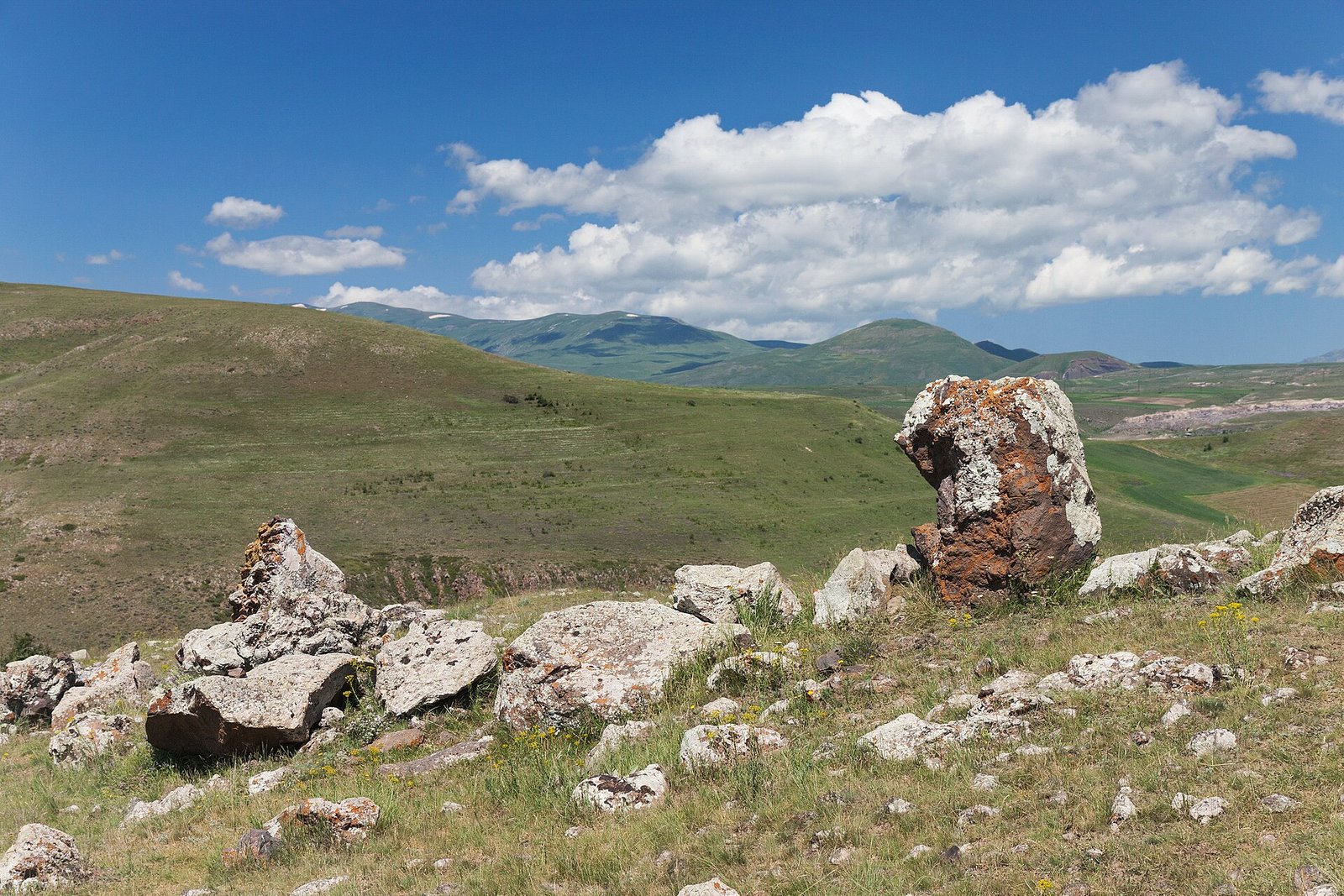
On the way, the Armenian Alphabet Monument, thirty nine carved stone letters standing in a field, is a five minute stop that people enjoy more than they expect to.
Getting there: tour, taxi, marshrutka or your own car
- Organised tour. Simplest option. Shared group day tours from Yerevan typically run around 25 to 60 EUR per person in 2026 depending on distance and what is included. Private tours cost more but you set the pace.
- Taxi for the day. Very common and reasonable. Agree the price and the itinerary in writing before you set off. Expect roughly 40 to 70 EUR for a full day, more for the Areni and Noravank distance. Ask your guesthouse to arrange it rather than flagging one on the street.
- Marshrutka. Minibuses run from Yerevan’s bus stations to towns for a euro or two, but they stop in villages, not at monasteries. Fine for Sevan town, Echmiadzin and Dilijan; awkward for Geghard, Noravank and Amberd.
- Rental car. From about 30 to 50 EUR a day. Roads are signposted in Armenian and Latin script, drivers are assertive but not aggressive, and fuel is cheap. Avoid driving mountain roads after dark.
Our transport guide for Armenia goes into more detail on each option.
We run small group and private day trips from Yerevan for independent and solo travellers, with guides who grew up in these valleys. Browse all our tours, or go straight to the two that fill up first: the Garni and Geghard half day and the Khor Virap, Areni and Noravank full day.
Which ones to choose
If you have one day: Garni and Geghard in the morning, back in Yerevan for a long lunch. It is the best ratio of wonder to driving in the country.
If you have two days: Add Khor Virap with Noravank and Areni. You get Ararat, the red gorge and the wine in a single long, satisfying day.
If you have three: Add Sevan and Dilijan for the contrast. Going from the dry Ararat plain to a forested green valley in ninety minutes is one of the odd pleasures of travelling here.
If you have four or more: Stop day tripping. Take the Sevan and Dilijan day trip as your last one out of Yerevan, then move your base and head south toward Tatev or north into Lori. Armenia gets better the further you get from the capital, and sleeping in a village guesthouse is a different experience altogether.
Practical notes for any of these
- Leave early. Light is better, the sites are emptier, and afternoon haze hides the mountains.
- Monasteries are working churches. Shoulders and knees covered, hats off for men, quiet voices. Women are not required to cover their hair at most sites but scarves are usually available at the door.
- Carry cash in small notes. Village cafés, entry donations and roadside honey sellers do not take cards.
- Most monasteries are free to enter. Garni and Zvartnots charge a small ticket, usually a couple of euros.
- Bring water and a layer. Mountain weather changes fast and even in summer the higher sites are cool by late afternoon.
Pick two directions, not five, and you will come back to Yerevan each evening with the feeling that you saw something rather than passed it.
Frequently asked questions
What is the best day trip from Yerevan?
Garni and Geghard is the one nobody regrets. It combines a first century pagan temple on a gorge edge with a monastery carved into solid rock, both within 45 minutes of the city, and takes only half a day. If you have a full day and want the mountain, choose Khor Virap paired with Noravank and Areni instead.
Can you visit Lake Sevan and Dilijan in one day from Yerevan?
Yes, comfortably. Sevan is about 65 km from Yerevan and Dilijan another 40 km beyond it, so the whole loop is roughly 250 km of driving. A typical day leaves at nine, stops at Sevanavank monastery, has lunch by the water or in Dilijan, walks the restored Sharambeyan Street and returns by early evening.
Do I need a tour or can I do day trips independently?
Both work. Marshrutka minibuses reach most towns cheaply but rarely go to the monasteries themselves, so you end up walking or hitching the last stretch. Hiring a taxi for the day is the common independent solution and costs roughly 40 to 70 EUR depending on distance. A guided tour costs more but adds context that makes the difference at places like Geghard.
How many day trips should I plan?
Two or three is the right number for a week in Armenia. Any more and you spend your holiday in a car returning to the same hotel. After two or three, it is better to move your base south to Yeghegnadzor or Goris, or north to Dilijan, and keep exploring from there.