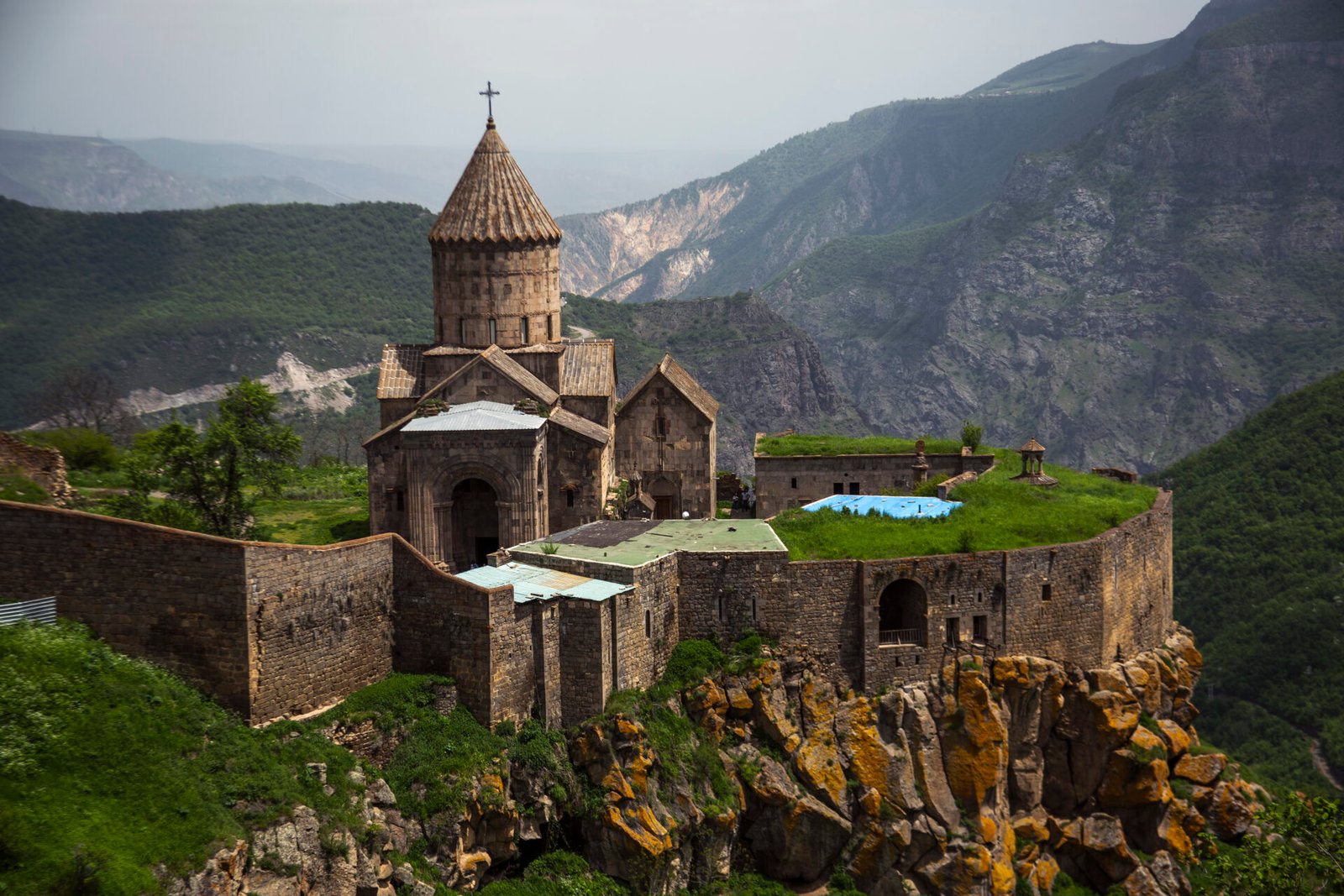
Tatev Monastery sits on a basalt shelf above the Vorotan gorge in southern Armenia, a fortified tenth century complex that was once the intellectual centre of the whole region. Most visitors arrive on the Wings of Tatev, the 5.7 kilometre cable car that holds a Guinness World Record. This guide covers the history, the gorge, Devil’s Bridge, and exactly how to get there from Yerevan.
| Quick facts | |
|---|---|
| Where | Tatev village, Syunik province, southern Armenia |
| Distance from Yerevan | About 250 km, 4 to 4.5 hours by road |
| Monastery founded | 895 to 906 AD, on a much older sacred site |
| Cable car length | 5,752 m, opened October 2010 |
| Ride time | Roughly 12 minutes each way |
| Return ticket | Roughly 9,000 to 10,000 AMD in 2026, around 20 to 25 euros |
| Base town | Goris, 40 km away, best place to sleep |
| Best months | May to June and September to October |
Why Tatev is worth the long drive
Armenia has a great many monasteries, and after a week here you will have seen a lot of dark stone and a lot of khachkars. Tatev is different, and the difference is the setting. The complex stands on a promontory with the ground falling away on three sides into a gorge nearly a kilometre deep. There is no comfortable viewpoint from which to photograph it from the outside. You either fly over it in the cable car or you stand inside its walls, and both feel like an event.
It was also, for several centuries, the most important place in Armenia that was not a cathedral. The Tatev University of the fourteenth and fifteenth centuries taught theology, philosophy, music and manuscript illumination, and at its height several hundred students and scribes worked here. Grigor Tatevatsi, the theologian buried in the small mausoleum against the main church, is still a name every Armenian schoolchild knows. When you walk the courtyard you are walking through what was effectively a medieval research institute that happened to be built like a fortress.
If you are building a monastery route through the country, read our guide to the best monasteries in Armenia to see how Tatev fits alongside Geghard, Noravank and Haghpat.
A short history of the monastery
The main church, Surb Poghos-Petros (Saints Paul and Peter), was consecrated in 906 under Bishop Hovhannes. The site was chosen because it was defensible: Syunik was a frontier province, and for most of its history Tatev was as much a stronghold as a place of prayer. At its medieval peak the monastery controlled hundreds of surrounding villages and ran its own economy.
Earthquakes have done more damage here than armies. The quake of 1931 brought down the drum and dome of the main church and destroyed the bell tower, and the reconstruction you see today dates largely from the following decades and from restoration work continuing into this century. Look closely at the stonework and you can read the repairs.
The Gavazan column
In the courtyard stands an eight metre octagonal pillar topped with a khachkar, erected in 904. It is hinged at the base in a way that lets it sway and then right itself, a response to earth tremors and, according to the story, to approaching cavalry. Guides will tell you it warned the monks of invaders. Whether or not that is literally true, it is a genuinely remarkable piece of medieval engineering and it is the thing most visitors remember.
The oil mill and the fortifications
Do not skip the restored oil press in the lower part of the complex, where sesame and linseed were crushed for lamp oil and food. It is a reminder that this was a working settlement with granaries, stables and workshops, not just a church. The outer walls, the gatehouse and the surviving towers make the fortress character obvious as soon as you walk the perimeter.
The Wings of Tatev cable car
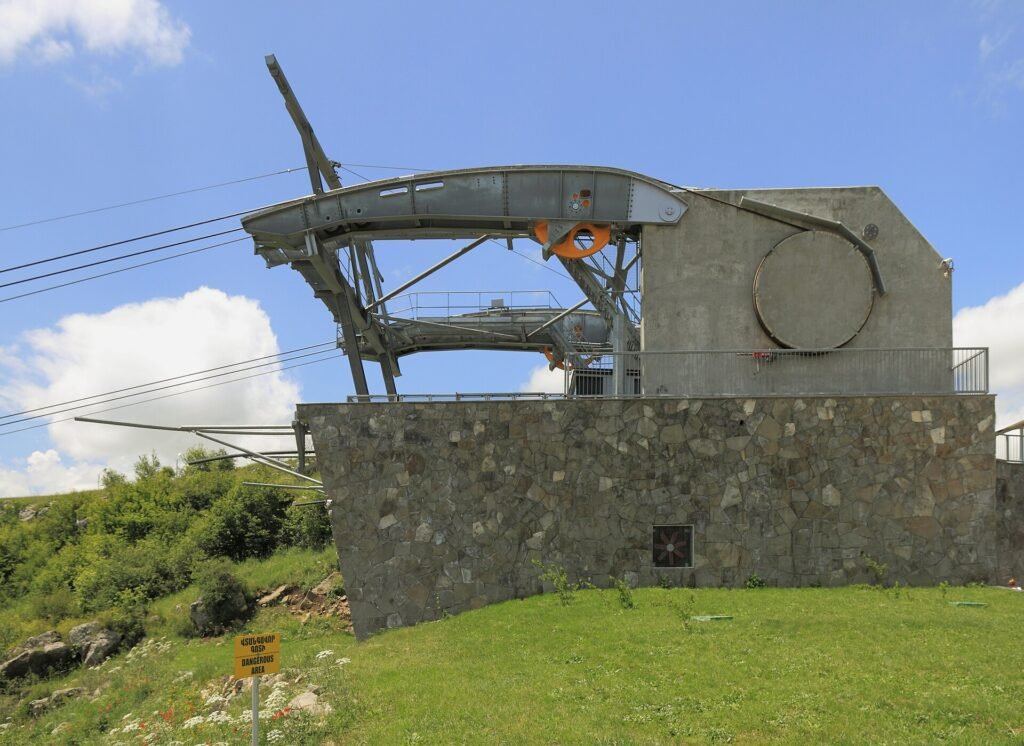
The Wings of Tatev opened in October 2010 and runs 5,752 metres from the village of Halidzor on the eastern rim of the gorge to Tatev village, beside the monastery. It holds the Guinness World Record as the longest non-stop double track reversible aerial tramway in the world. Two cabins move in opposite directions on the same run, each carrying about 25 standing passengers, and the crossing takes around twelve minutes.
Between the towers the cabin hangs several hundred metres above the Vorotan river, and the second span in particular is genuinely dramatic: the floor of the gorge simply drops away and you can see the old road switchbacking down into the trees. If you want a specific spot, stand at the downhill end of the cabin facing the monastery on the outbound leg. Nobody has ever regretted paying for the return ticket.
Practical points
- Buy a return ticket unless you have a driver taking your car down the old road to meet you.
- The cable car has historically closed one day a week for maintenance and does not run in strong wind, fog or storms. Check the operator’s current timetable the day before.
- In July and August, and on Armenian public holidays, there can be a wait of an hour or more at Halidzor. Arrive early in the morning.
- Cabins are standing room only. It is fine for most people but if you are uneasy with heights, stand in the middle and look at the far rim rather than straight down.
- There is a cafe and a shop at the Halidzor station, and clean toilets at both ends.
Devil’s Bridge and the floor of the gorge
If you drive down the old road instead of flying over it, you reach Satani Kamurj, Devil’s Bridge. This is not a built bridge at all but a natural travertine arch where the Vorotan river runs underneath a crust of mineral deposits laid down over thousands of years. Warm springs seep through the rock and have stained it rust orange, ochre and green, and there are shallow pools where locals soak on hot days. Small caves open off the riverbank.
Getting there means about twenty minutes of hairpins on a road that is narrow but paved and perfectly manageable in a normal car. Come in swimwear if the weather is warm and bring flip flops, because the rock is sharp. In spring the water runs high and cold and the pools are less appealing, but the gorge itself is at its greenest.
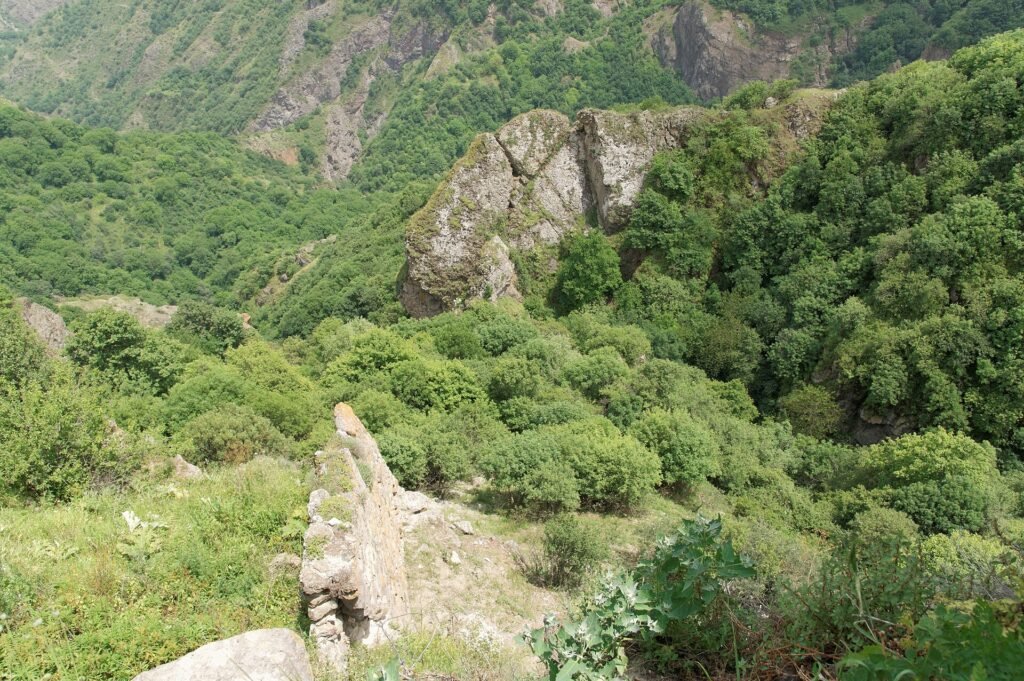
Above the road on the Tatev side, hidden in the trees, is Tatevi Anapat, the seventeenth century hermitage where monks withdrew from the busier main monastery. It is half ruined, almost always empty, and worth the short detour if you have your own vehicle.
Getting to Tatev from Yerevan
The drive runs south on the M2 through Ararat province, past the turn for Khor Virap, up over Vayots Dzor and the Vorotan pass at 2,344 metres, and down into Syunik. It is around 250 kilometres and realistically four to four and a half hours without stops. The road is good tarmac almost the whole way but it climbs and winds, so do not plan it as if it were a motorway.
Your options
- Organised tour. The simplest choice, and what most solo travellers pick. Our two day Tatev and Wings of Tatev tour includes a night in Goris and stops at Areni and Noravank on the way.
- Hired car with driver. Expect roughly 100 to 140 euros a day for the vehicle and driver in 2026, split between however many of you there are.
- Self drive. Entirely doable. Fuel is cheap, the road is signposted, and the only real hazards are livestock and the occasional pothole after the pass.
- Marshrutka. Minibuses run from Yerevan’s Sasuntsi David station to Goris and Kapan, usually departing in the morning. They are cheap, slow and not designed around sightseeing. See our guide to getting around Armenia for how the system works.
Doing Tatev as a single day from Yerevan is possible and plenty of people do it, but you will spend nine hours in a vehicle for about three hours on the ground. If your schedule allows only one long day out of the capital, our list of day trips from Yerevan has better value options closer to the city.
Staying in Goris
Goris is the right base. It is forty kilometres from the cable car, laid out on a neat nineteenth century grid of stone houses under strange eroded rock pinnacles, and it has the best choice of guesthouses in southern Armenia. Expect to pay roughly 25 to 50 euros for a double room with breakfast in 2026, less in a simple family guesthouse.
Spend the evening walking up to Old Khndzoresk, the abandoned cave settlement fifteen minutes away where families lived in carved rock dwellings until the 1950s, now reached by a swinging footbridge across the ravine. It makes a perfect late afternoon after the monastery.
We run small group and private trips to Tatev for independent travellers, with a real guide who knows the gorge and time built in for Devil’s Bridge rather than a rushed photo stop. See our tours and tell us what you want to see.
When to go
Late May to June and September to mid October are the best windows. The gorge is green in spring, golden in autumn, and the cable car is less crowded outside July and August. Winter visits are beautiful and the monastery in snow is extraordinary, but the mountain roads in Syunik can close after heavy falls and the light goes early. Our guide to the best time to visit Armenia goes into the seasons in detail.
Combining Tatev with the rest of the south
Tatev is the anchor of any southern itinerary. Coming from Yerevan you pass through Vayots Dzor, so it makes obvious sense to stop at Areni and Noravank, which we cover in our Noravank and Areni wine region guide. Continue south from Goris and you reach Kapan, the Shikahogh forest and eventually Meghri on the Iranian border. Our southern Armenia road trip article maps the whole route.
Practical notes for the day
- Dress modestly inside the churches. Women are not required to cover their heads at Tatev but shoulders and knees should be covered.
- There is no entry fee for the monastery itself. Donations are welcome.
- Bring water and a hat. The shelf is exposed and there is very little shade.
- Mobile signal is patchy in the gorge and good at the monastery.
- Cash in drams is useful in Tatev village and in Goris guesthouses, though the cable car takes cards.
- Allow at least ninety minutes at the monastery. Two hours if you want to sit and look.
Frequently asked questions
How long is the Wings of Tatev cable car ride?
The ride takes about 12 minutes in each direction and covers 5,752 metres across the Vorotan gorge. The cabin holds around 25 standing passengers and crosses the gorge at heights of up to roughly 320 metres above the river. Most people find the return trip is over far too quickly.
Can you visit Tatev Monastery as a day trip from Yerevan?
Yes, but it is a long day. The drive is around 250 kilometres each way and takes four to four and a half hours in each direction, so a day trip means roughly nine hours in the car plus the monastery and cable car. Staying a night in Goris turns the same journey into a relaxed two-day trip.
Is the cable car ever closed?
Yes. The Wings of Tatev shuts for scheduled maintenance, historically one day a week, and it does not run in high wind, thick fog or thunderstorms. Always check the operator's current schedule and the weather before you drive south, and know that the old road down through the gorge is the backup.
What is Devil's Bridge near Tatev?
Devil's Bridge, or Satani Kamurj, is a natural travertine arch that the Vorotan river carved out for itself at the bottom of the gorge. Warm mineral springs seep out of the rock around it and have stained the stone orange and green. It sits directly below the monastery and is reached on the old road.
How much does the Wings of Tatev cost?
A return ticket has been in the region of 9,000 to 10,000 Armenian drams in recent seasons, roughly 20 to 25 euros, with a lower one-way fare and discounts for children and students. Prices change, so check the official site before you travel rather than trusting an old blog post.