Garni Temple and Geghard Monastery sit ten kilometres apart in the same valley east of Yerevan, and together they make the best half day in Armenia. One is a first-century Greco-Roman temple standing on a cliff edge; the other is a medieval monastery carved into solid rock. Here is how to do both well.
We run this trip several times a week, and the difference between a good version and a rushed one comes down to three decisions: what time you leave, whether you walk into the gorge, and whether you stop for lavash. All three are covered below.
| Quick facts | Detail |
|---|---|
| Distance from Yerevan | Garni 28 km, Geghard 38 km |
| Drive time | 40 min to Garni, 15 min more to Geghard |
| Garni Temple built | 1st century AD, reconstructed 1969 to 1976 |
| Geghard founded | 4th century, main church 1215 |
| UNESCO status | Geghard and the Upper Azat Valley, inscribed 2000 |
| Entrance | Garni paid, Geghard free |
| Time needed | 4 to 5 hours from your hotel |
| Best light | Garni morning, Geghard late afternoon |
Why this is the trip everyone does first
Most countries make you choose between antiquity and the Middle Ages. Here you get both in one valley, and they explain each other. Garni is what Armenia looked like as a Hellenised client kingdom orbiting Rome. Geghard is what it became after 301 AD, when Christianity was adopted as the state religion and the same stone-working skill turned inward, literally, into the cliff.
The drive itself is short but the landscape changes fast. You leave the flat outskirts of the city, cross the Azat river gorge, and by the time you reach Garni village the basalt walls are already three hundred metres deep below the road.
Garni Temple: a Roman building that refused to disappear
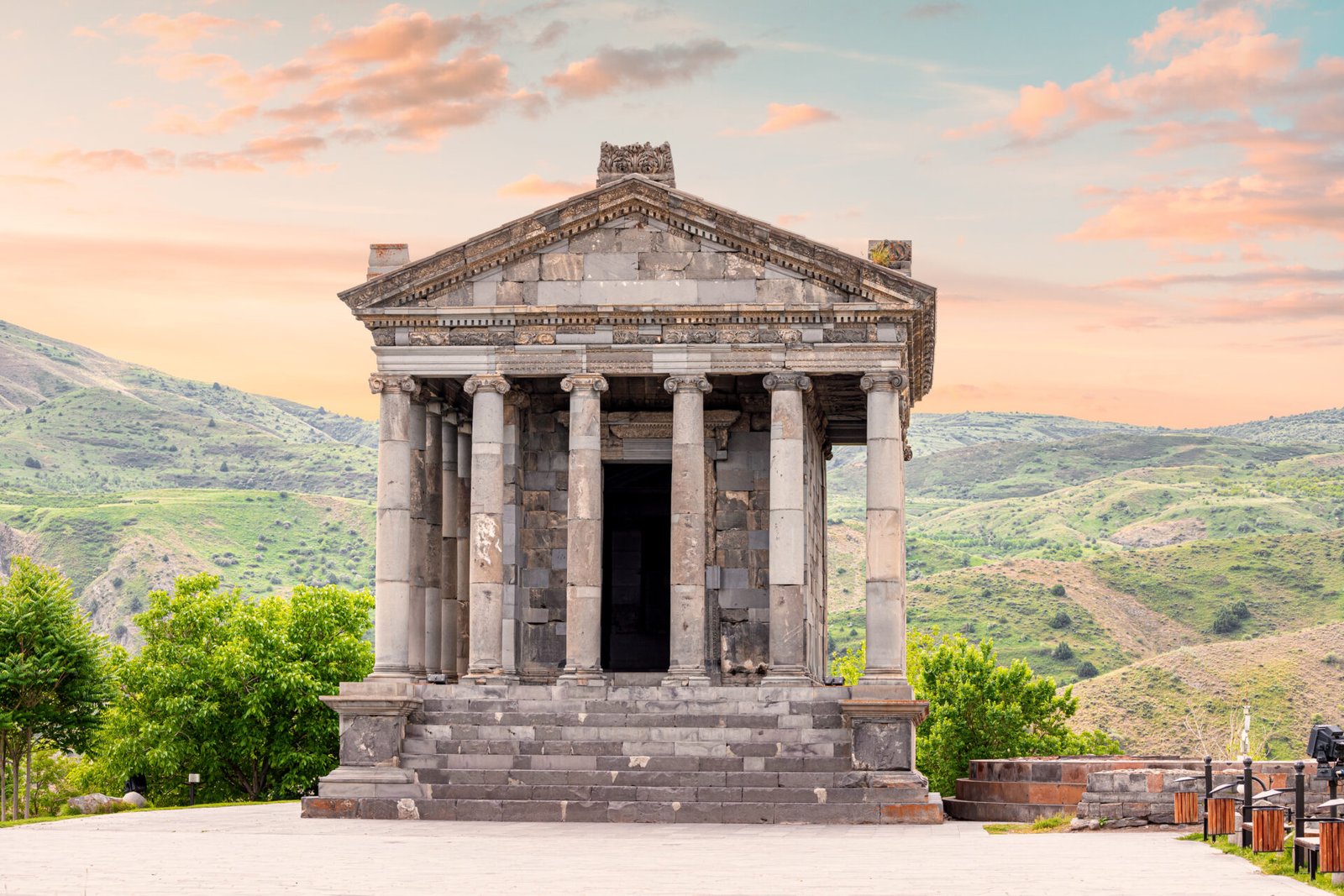
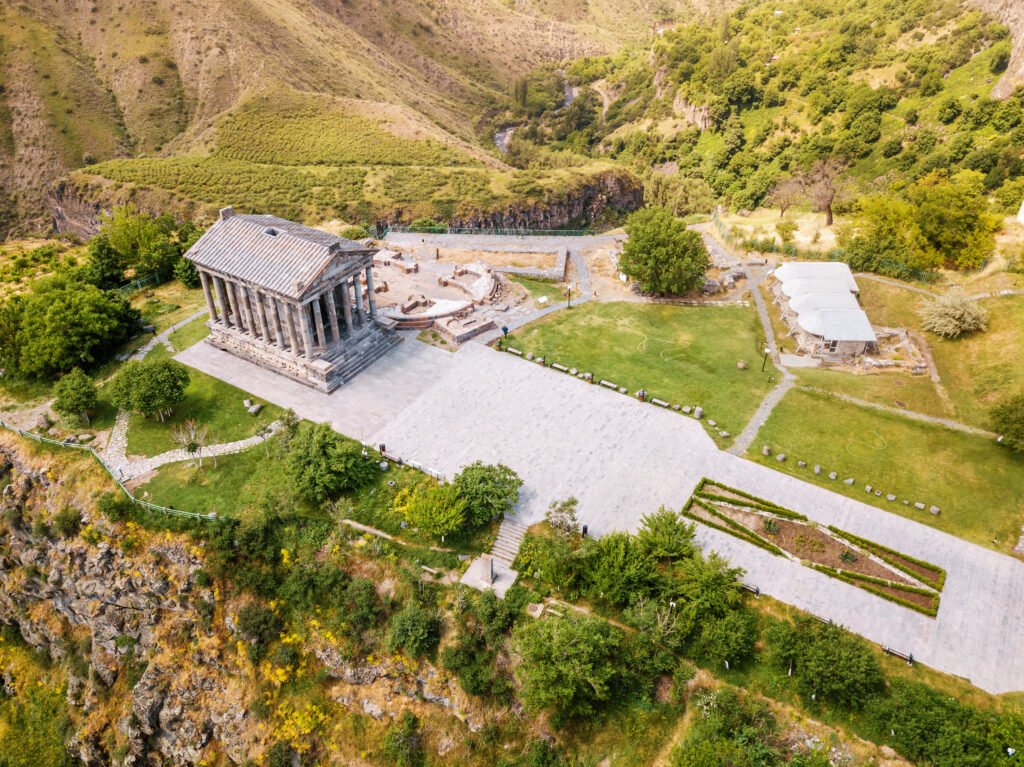
The temple is a peripteral Ionic building with twenty-four columns, raised on a high podium with nine steep steps, and it is the only Greco-Roman colonnaded structure left standing anywhere in the former Soviet Union. It is usually dated to the first century AD and attributed to King Tiridates I, who visited Rome in 66 AD, was crowned by Nero, and came home with money and craftsmen. Whether it was a temple to the sun god Mihr or a royal summer pavilion is still argued over by archaeologists. Either reading works when you stand in front of it.
What you see today is a reconstruction, and honestly so. A severe earthquake in 1679 brought the building down, and it lay as a heap of numbered blocks until the Soviet architect Alexander Sahinyan rebuilt it between 1969 and 1976 using anastylosis, putting original stones back in their original positions and marking the new infill in plain, undecorated stone. Look closely at the columns and you can see which drums are ancient and which are not. That honesty is the best thing about the restoration.
The bathhouse and its mosaic
Do not walk past the low modern shelter beside the temple. Inside are the remains of a third-century Roman bath complex with hypocaust heating and a surviving floor mosaic in pale sea colours showing Ocean and Sea personified, framed by a Greek inscription that translates roughly as “we worked without receiving anything”. Twenty centuries later, an unpaid craftsman’s complaint is still the most human thing on the site.
The rest of the plateau holds the foundations of a royal palace, a seventh-century church, and the old fortress walls. An Urartian inscription found here records King Argishti I taking the fortress of Giarniani in the eighth century BC, which makes this one of the longest continuously fortified spots in the country.
The Symphony of Stones in the Azat gorge
Below the temple, the Azat river has cut through an old lava flow and exposed a cliff of hexagonal basalt columns hanging down like organ pipes. Armenians call it the Symphony of Stones, and it is geologically the same phenomenon as the Giant’s Causeway, only vertical and above your head.
Getting there is straightforward. A paved road drops from Garni village into the gorge, about 1.5 kilometres, roughly 25 to 30 minutes down and closer to 45 back up because the return is all uphill in the sun. Local drivers wait near the temple car park with old 4x4s and will run you down and back for a few thousand dram. If your knees are fine, walk down and ride up. The riverbed at the bottom is a good picnic spot and the temple looks enormous from below.
Allow an hour for this. It is the part most tour groups skip and the part independent travellers remember.
Lavash baking in Garni village
Several families in the village bake lavash in a tonir, a clay oven sunk into the floor, and let visitors watch or try. The dough is stretched over a padded cushion and slapped against the wall of the pit, where it bakes in under a minute. Getting it to stick is harder than it looks, and getting it off before it burns is harder still.
Lavash was added to the UNESCO list of intangible cultural heritage in 2014, not as a recipe but as a social practice, because in villages the baking is done collectively by several women over a whole day. Most places will serve what you bake with cheese, herbs and a glass of something. It costs a few thousand dram per person and it is the best-value stop in the valley. More on this in our guide to Armenian food.
Geghard Monastery: churches cut out of the mountain
Ten minutes further up the valley the road ends at a wall of cliffs, and Geghard is built into them. The monastery’s original name was Ayrivank, the Monastery of the Cave, and tradition places its foundation in the fourth century with Gregory the Illuminator himself. Arab raids destroyed the early complex. What stands now dates mostly from the thirteenth century, when the Zakarian and then the Proshyan princes rebuilt it.
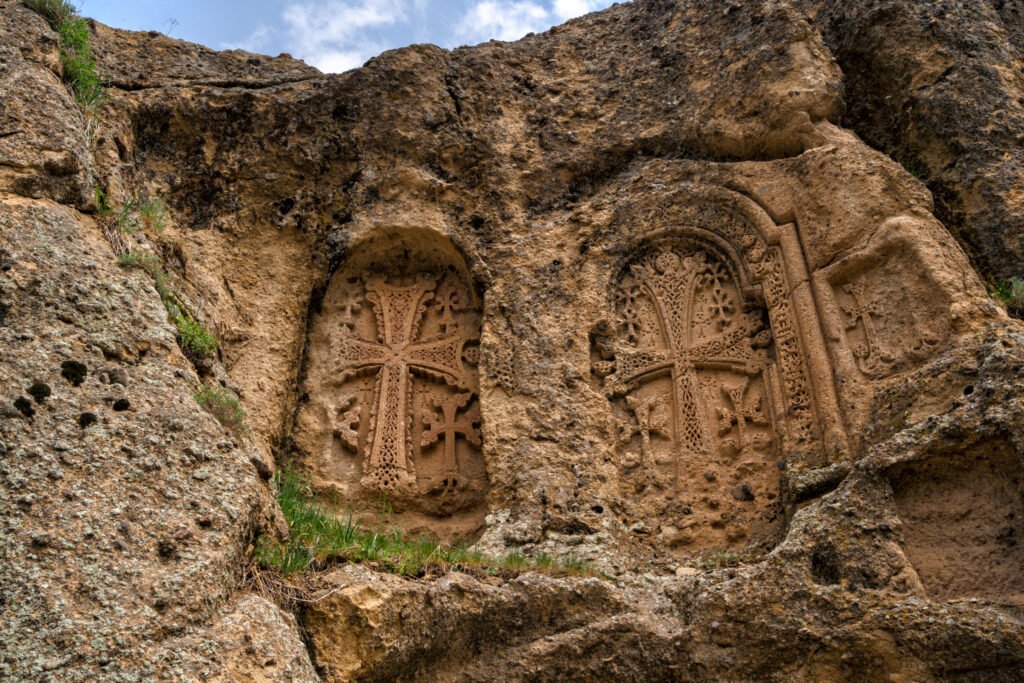
The main church, Katoghike, was completed in 1215. Behind and around it are the extraordinary parts. The Avazan chapel, carved in 1283 by a mason who signed himself Galdzag, was hollowed straight out of the rock around a spring that still runs; you can hear it before you see it, and people dip their hands in. The Proshyan family burial chamber above carries a relief of two chained lions and an eagle gripping a lamb, the family arms, cut into the living rock of the ceiling.
The whole of it, including the gavit with its great central oculus, was carved downwards from the top with hammer and chisel. There are no joints, because there are no blocks. That is the fact worth holding on to as you walk through.
The monastery is named for the geghard, the lance said to have pierced Christ’s side, brought to Armenia by the Apostle Thaddeus and kept here for centuries. It is now in the treasury at Etchmiadzin. Geghard and the Upper Azat Valley were inscribed by UNESCO in 2000.
Listen before you leave
Armenian a cappella groups sing in the gavit and the rock chapels most days, usually a sharakan or a Komitas arrangement. There is no timetable and no charge, though they sell CDs. If you hear voices when you arrive, go towards them first and photograph afterwards. The reverberation in a chamber cut from one piece of stone is something no concert hall reproduces.
How to get to Garni and Geghard
By organised tour
The simplest option, and the only one that reliably includes the lavash stop and the gorge. Our Garni and Geghard half-day tour leaves in the morning and is back in Yerevan for a late lunch.
By taxi
Negotiate a return trip with waiting time at both sites. Expect roughly 12,000 to 20,000 dram in 2026, around 28 to 47 euros, depending on how long you keep the driver and how well you bargain. Agree the price and the waiting time before you get in. Yandex Go and GG work well inside Yerevan but are less dependable for a return trip with stops.
By marshrutka
Minibus 284 runs from Yerevan to Garni village roughly hourly for a few hundred dram, leaving from the Gai bus station area. There is no dependable public service on to Geghard. The usual solution is to take the marshrutka to Garni, see the temple, then share a taxi for the last ten kilometres with other travellers at the car park. Budget travellers do this every day and it works, but do not attempt it late in the afternoon, when the last minibus back can leave earlier than you expect. See our transport guide for the wider picture.
We are a small Yerevan operator and this is the trip we run most. Small groups, a proper stop at the gorge, and no gift-shop detours. Browse our tours and pick your morning.
When to go, and in what order
Leave by nine. Garni faces east and the temple takes morning light beautifully, while Geghard sits under high cliffs that put the courtyard in shade by mid afternoon, which is exactly when the carved interiors look best. Doing Garni first and Geghard second is therefore both the geographic and the photographic order.
Spring and autumn are ideal. In May the gorge is green and the river loud with snowmelt. October gives you clear air and fewer coaches. July and August are hot on the exposed Garni plateau, so go early. In winter Geghard with snow on the cliffs is extraordinary and nearly empty, though the gorge road to the Symphony of Stones can be icy and the 4×4 drivers may refuse it.
Practical notes
- Wear shoes with grip. Both sites have worn, uneven stone.
- Bring small cash for the Garni ticket, candles, the village stalls and the 4×4 into the gorge.
- Shoulders and knees covered at Geghard. No head covering required.
- There are toilets at both car parks and cafes in Garni village, but almost nothing at Geghard except stalls selling sujukh and dried fruit. Buy the sujukh.
- Photography is allowed inside Geghard. Step aside during services.
What to combine it with
Garni and Geghard take half a day, which leaves the afternoon free. The easy pairing is a walk through central Yerevan and the Cascade, covered in our list of things to do in Yerevan. If you have a full day and a car, some people add Lake Sevan, though that makes for a long haul. A better use of a second day is the southern run to Khor Virap and Mount Ararat.
If this valley leaves you wanting more medieval stone, our guide to the best monasteries in Armenia ranks the ten worth travelling for, and our list of day trips from Yerevan covers everything reachable and back before dark.
Frequently asked questions
How long does the Garni and Geghard trip take from Yerevan?
Four to five hours door to door is realistic if you want to see both properly. Garni is about 40 minutes from the centre and Geghard another 15 minutes up the valley. Add an hour if you walk down to the Symphony of Stones, and another 45 minutes for a lavash baking stop and lunch in the village.
Is there an entrance fee for Garni Temple and Geghard Monastery?
Garni charges an entrance fee because it is a state-run archaeological site, roughly 1,500 to 2,500 dram for foreign visitors in 2026, which is about three to six euros. Geghard is a working monastery and free to enter. Prices change, so confirm at the gate rather than relying on older blog posts.
Can I visit Garni and Geghard by public transport?
Partly. Marshrutka 284 runs from Yerevan to Garni village roughly every hour for a few hundred dram, but there is no reliable bus onward to Geghard. Most independent travellers take the marshrutka to Garni and then negotiate a short taxi for the last ten kilometres, or share one with other visitors at the temple car park.
What is the Symphony of Stones?
It is a wall of hexagonal basalt columns in the Azat gorge below Garni village, formed when a lava flow cooled slowly and cracked into regular prisms. The columns hang down like organ pipes above the river. It is about 1.5 kilometres from the temple along a paved road, walkable in half an hour downhill.
Is Geghard Monastery really carved into the rock?
Yes. Several of its chambers, including the Avazan chapel with its internal spring and the upper zhamatun, were cut directly out of the solid cliff rather than built from blocks. The masons worked downwards from the top, which is why the vaults and columns are carved from one continuous piece of stone.