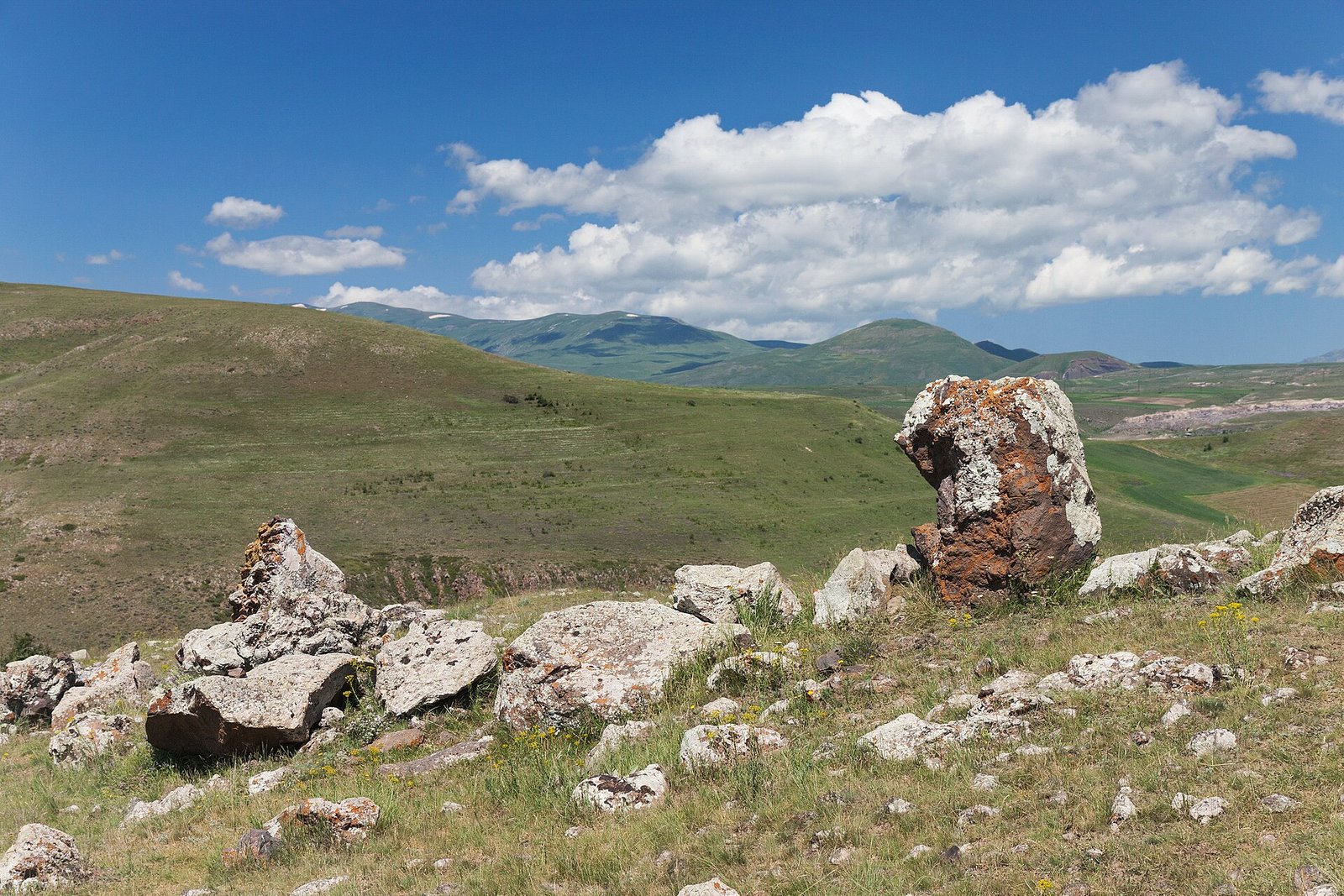
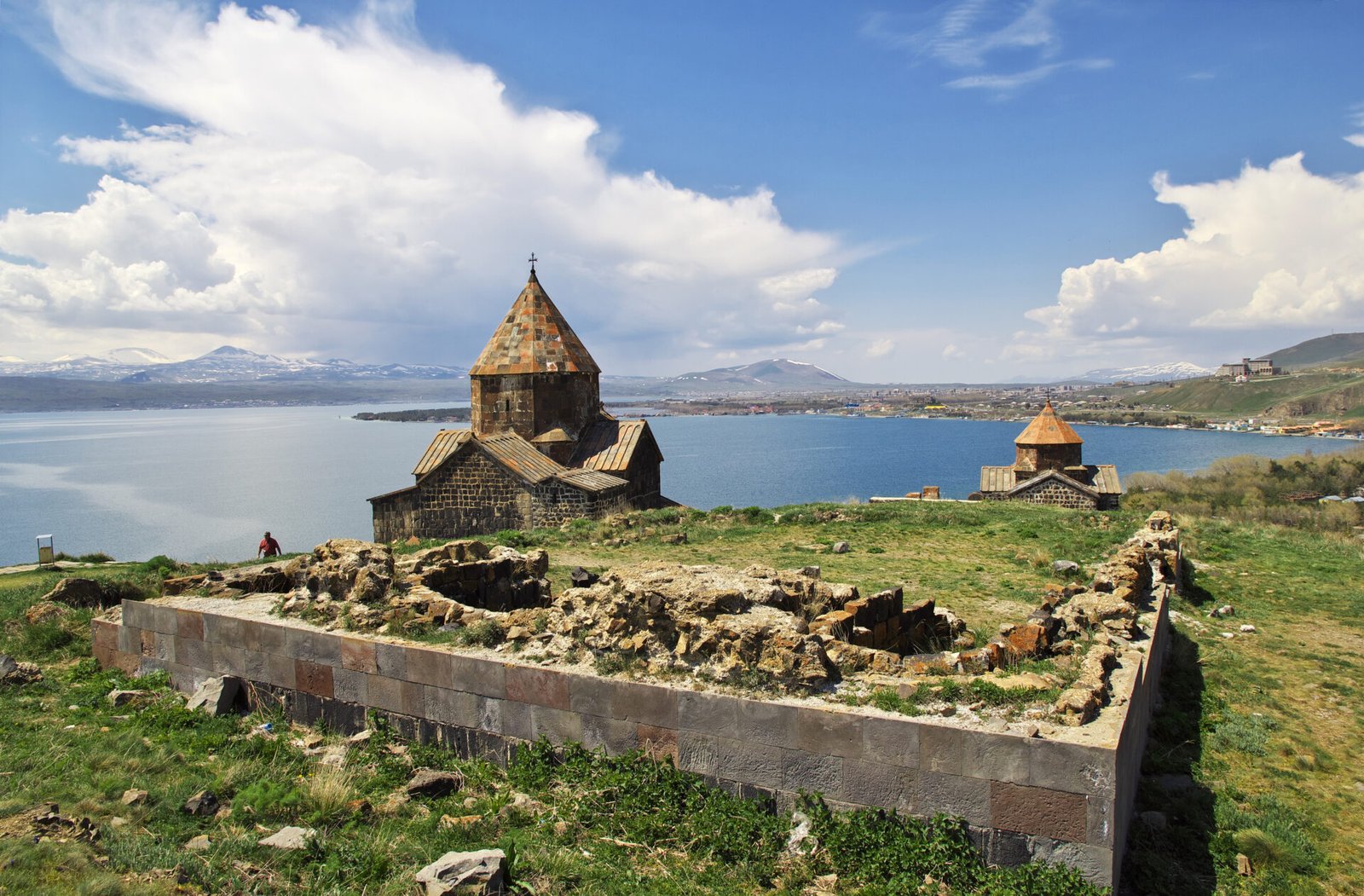
Lake Sevan is Armenia’s inland sea: 1,240 square kilometres of hard blue water at almost 1,900 metres above sea level, ringed by bare mountains and dotted with medieval monasteries. It is an hour from Yerevan, it is where Armenians go to swim, and it is the easiest big landscape in the country to reach. Here is how to see it properly.
| Quick facts | |
|---|---|
| Altitude | About 1,900 m above sea level |
| Surface area | Around 1,240 km2, the largest lake in the Caucasus |
| Distance from Yerevan | 65 km to Sevan town, just over an hour |
| Swimming season | Late June to early September, water 19 to 22 C |
| Main sights | Sevanavank, Hayravank, Noratus cemetery, Artanish peninsula |
| Local speciality | Ishkhan (Sevan trout), sig whitefish, crayfish |
| Best base for a night | Tsapatagh or Shorzha on the eastern shore |
| Bring | Sunscreen, a windproof layer, cash in drams |
What Lake Sevan actually feels like
People arrive expecting an alpine lake and find something stranger. There are no forests coming down to the water on most of the shoreline. Instead there are treeless brown and green slopes, enormous skies, and a lake so large that on a hazy day you cannot see the far side. The light at this altitude is intense and the water shifts from turquoise to steel grey to almost black within an hour.
It is also a working lake, not a resort. Fishing boats, Soviet era sanatoriums in various states of repair, new glass hotels, cattle on the road, families grilling on the beach. Come expecting something polished and you will be disappointed. Come expecting the biggest, oldest, most used landscape in Armenia and you will love it.
The water level story
From the 1930s Soviet planners drained Sevan for irrigation and hydroelectricity, dropping the level by roughly nineteen metres. That is why Sevan island is now a peninsula, and why you can see the tide line of old shoreline on the hills. Since the 1980s water has been diverted back into the lake through tunnels from the Arpa and Vorotan rivers and the level has slowly risen again, drowning some of the buildings put up on the exposed shore. Half the odd sights around the lake are explained by this single fact.
Sevanavank monastery
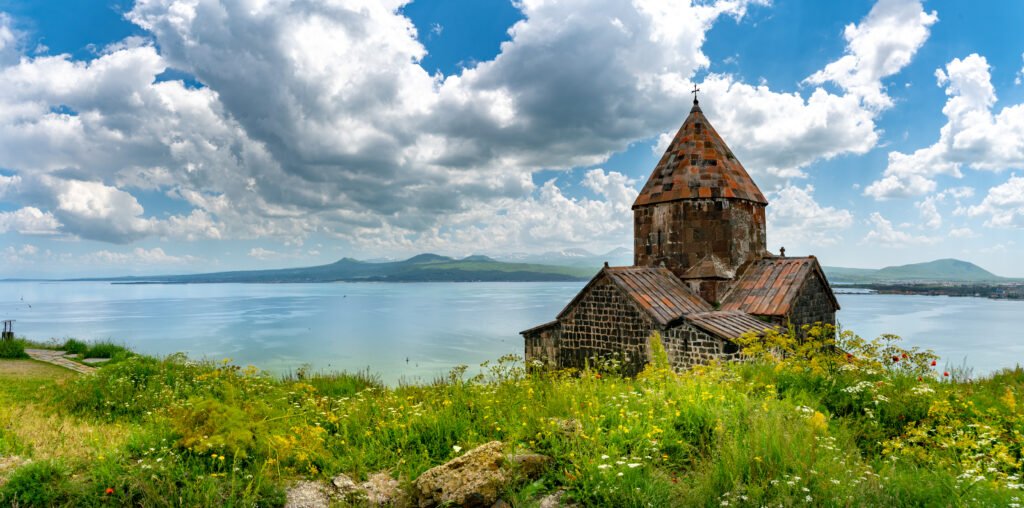
Sevanavank is the image of the lake that everyone knows: two dark churches on a bare green headland with water on three sides. It was founded in 874 by Princess Mariam, daughter of King Ashot I Bagratuni, on what was then a genuine island. Two churches survive, Surb Arakelots (Holy Apostles) and Surb Astvatsatsin (Holy Mother of God), both small, unadorned and built from black tuff that looks almost charred.
Getting up there means a staircase of a couple of hundred steps. It is not difficult but remember you are at 1,900 metres and the air is thinner than you expect. The view from the top, with the peninsula falling away and the lake opening out, is the reason to come. Go early. By eleven in the morning in summer the car park is full of buses and the staircase is a queue.
Inside the churches, look for the khachkars set into the walls and the carved wooden fragments in the small museum below. Sevanavank is one of the country’s essential sites and we put it alongside Tatev and Geghard in our guide to the best monasteries in Armenia.
Hayravank, the quiet alternative
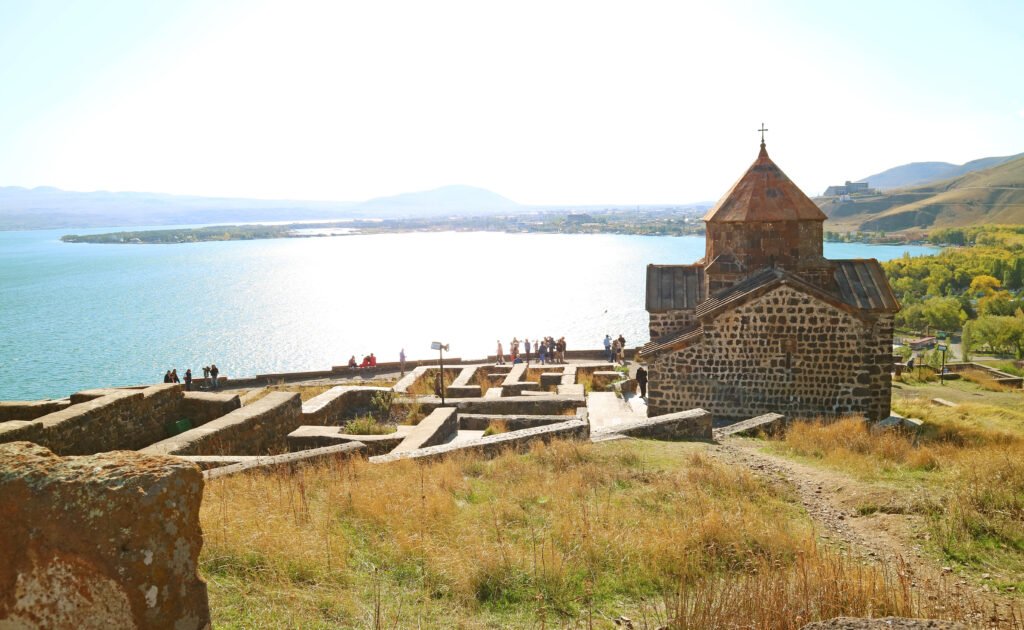
Twenty minutes down the western shore towards Noratus, Hayravank sits on a low rocky bluff right at the water’s edge. It dates from the ninth to twelfth centuries, it is much smaller than Sevanavank, and on most days you will have it more or less to yourself. Walk around the back to where the khachkars stand on the rock above the water. If you only have time for one monastery and you value quiet over the famous view, choose this one.
Noratus and the khachkar field
Near Gavar on the western shore, the cemetery at Noratus holds close to nine hundred khachkars, the carved cross stones that are Armenia’s signature art form. It is the largest surviving field of them anywhere, and the oldest date from the tenth century. What makes Noratus memorable is not just the number but the variation: each stone is an individual composition, some abstract lacework, some with scenes of a funeral feast or a wedding carved at the base.
There is usually a village woman selling hand knitted socks at the gate and sometimes a flock of sheep grazing between the stones. It costs nothing to enter. Allow forty minutes and go slowly. It is about ninety minutes from Yerevan and works naturally as a stop on a loop around the lake.
Beaches and swimming
The lake is cold. At 1,900 metres even a long hot summer only lifts the surface to about 19 to 22 degrees in late July and August, occasionally a degree or two more in a shallow bay. That is swimmable and Armenians swim happily, but it is not the Mediterranean and the first thirty seconds are a shock. Outside roughly late June to early September, plan on wading rather than swimming.
Where to go in the water
- Sevan town beaches. Closest to Yerevan, busiest, a strip of pay beaches with loungers, music and beer. Fine for an afternoon, not tranquil.
- The northwestern shore near Tsovagyugh. Easy to reach, a mix of free and paid stretches.
- The eastern shore, Shorzha and Tsapatagh. An hour or more further round and much quieter, with clearer water and small guesthouses. This is where to go if you want a swim without a sound system.
- Artanish peninsula. The wildest option, a rough track, no facilities, and empty shoreline. Bring everything you need.
Two warnings that locals take seriously. First, the wind. Sevan is calm in the morning and often blowing hard by mid afternoon, which raises real waves and drops the felt temperature fast. Swim early. Second, the sun. At this altitude you will burn in half the time you expect, even when the air feels cool.
Eating at the lake
Ishkhan, literally prince, is the endemic Sevan trout and the fish the lake is famous for. Wild populations crashed in the twentieth century and the wild catch is restricted, so what arrives on your plate is farmed. That is not a criticism: grilled whole over charcoal with nothing but salt and served with lavash and herbs, it is one of the best meals in Armenia. Sig, a whitefish introduced in the Soviet period, is cheaper and also good. Lake crayfish come boiled by the kilo and are a beer food.
Expect to pay roughly 4,000 to 7,000 drams for a whole grilled fish in 2026, around 9 to 16 euros, more at the polished places near Sevanavank. The best value is usually a simple roadside place on the eastern shore where nobody is aiming at tourists. For the wider picture, see our Armenian food guide.
Getting there and getting around
The M4 from Yerevan to Sevan town is a fast, good road and takes just over an hour. Marshrutkas leave regularly from the Northern bus station and cost very little, dropping you in Sevan town, from which it is a taxi or a hot walk to the monastery. A taxi or ride hailing app from Yerevan to Sevanavank and back with waiting time is entirely reasonable if there are two or three of you.
To do the lake properly you want a vehicle, because the sights are strung out over a hundred kilometres of shoreline. A sensible full loop is Sevanavank, then south down the western shore to Hayravank and Noratus, then either back or onward around the eastern side. The lake also pairs perfectly with Dilijan, which is only about forty minutes from Sevan through the tunnel, and that combination is the single best day out from the capital. Our Lake Sevan and Dilijan day trip does exactly that route.
Other options and rough costs are in our guide to day trips from Yerevan.
We run Lake Sevan trips for independent travellers who would rather stop at Noratus and eat where the locals eat than be herded up the monastery steps at noon. See our tours and we will build the day around what interests you.
Staying overnight
A night at the lake changes it. The buses leave, the wind drops at dusk, and the water goes completely still. The eastern shore around Tsapatagh and Shorzha has the best mix of small guesthouses and a handful of proper hotels, typically 30 to 70 euros for a double in 2026 and much more at the few high end places in August. Book ahead for July and August weekends, when Yerevan empties onto the shore.
Sevan town itself has cheap rooms but little charm. If you want comfort plus scenery, consider staying in Dilijan instead and driving out to the lake, which is what many visitors end up preferring.
When to visit
July and August for swimming, and accept the crowds. June and September are the sweet spot: warm days, thin traffic, and the water still just about tolerable in early September. May is green and beautiful but cold in the water. Winter has its own appeal, with snow on the surrounding ranges, sections of shallow bay freezing over and Sevanavank almost empty, though many lakeside businesses shut down completely. Our best time to visit Armenia guide breaks down the whole calendar.
Practical notes
- Bring cash. Small beaches, roadside fish restaurants and village guesthouses often do not take cards.
- Pack a windproof jacket even in July. Evenings at 1,900 metres are genuinely cool.
- Cover shoulders and knees inside the churches.
- Public beaches charge a small entry fee, usually a few hundred to a couple of thousand drams, sometimes including a lounger.
- There is no lifeguard culture. The lake is deep and cold and gets choppy. Stay near the shore.
- Fuel and ATMs are available in Sevan town and Gavar, thin on the eastern shore.
Frequently asked questions
Can you swim in Lake Sevan?
Yes, from roughly late June to early September. The lake sits at about 1,900 metres, so the surface water only reaches a comfortable 19 to 22 degrees in July and August, occasionally a little more in a hot year. Outside those weeks it is cold enough that most people just paddle.
How far is Lake Sevan from Yerevan?
The nearest shore at Sevan town is about 65 kilometres from Yerevan and takes just over an hour on the M4 highway. Sevanavank monastery is a few minutes beyond that. The eastern and southern shores, such as Tsapatagh or Noratus, add another forty minutes to an hour and a half.
What is ishkhan and can you still eat it?
Ishkhan means prince fish, the endemic Sevan trout. Wild stocks collapsed in the twentieth century and wild catch is restricted, so what you eat in a lakeside restaurant is almost always farmed ishkhan. It is genuinely good grilled whole over coals. Sig, an introduced whitefish, and lake crayfish are the other local specialities.
Is Lake Sevan worth an overnight stay?
If you only want Sevanavank, a half day from Yerevan is enough. If you want beaches, Noratus, Hayravank and a quiet morning on the water, stay a night on the eastern shore around Tsapatagh or Shorzha, or combine the lake with Dilijan, which is only forty minutes away through the tunnel.
Why did the water level of Lake Sevan drop?
Soviet engineers drained the lake heavily from the 1930s for irrigation and hydropower, lowering it by around nineteen metres and turning Sevan island into a peninsula. Water has been diverted back through tunnels since the 1980s and the level has been slowly recovering, which is why some shoreline buildings now stand in the water.