Armenian food is built on fire, bread, herbs and fruit, and it is far more varied than the plates of grilled meat most visitors expect. This guide covers what to order, what things actually taste like, where to eat in Yerevan and beyond, what a meal costs in 2026, and how to eat well here if you do not eat meat.
| Quick orientation | |
|---|---|
| Signature dish | Khorovats, meat grilled over wood |
| The bread | Lavash, on the UNESCO intangible heritage list since 2014 |
| Best market | GUM Market in Yerevan for dried fruit, cheese and spices |
| Main course, mid range | Roughly EUR 6 to EUR 14 in 2026 |
| Vegetarian | Genuinely easy thanks to the church fasting tradition |
| Fruit season | Apricots late June and July, pomegranates October and November |
| Meal times | Lunch 13:00 to 15:00, dinner from 20:00, late is normal |
Lavash, and why the bread comes first
Lavash is a paper thin flatbread slapped onto the inner wall of a tonir, a clay oven sunk into the ground, and peeled off in seconds. UNESCO inscribed it in 2014, and the listing is really about the practice: women working in pairs, the rhythm of it, the way stacks of it are dried and stored for months and revived with a splash of water.
At the table it is not a side. You tear it, wrap things in it, use it as a plate, a napkin and a utensil. Grilled meat goes into it with raw onion and herbs. Cheese and tarragon go into it and become a snack called a brdutch. If you are offered a piece torn by hand, take it with your hand.
Alongside it look for matnakash, a soft ridged loaf that is the everyday city bread, and the round tonir hats.
Khorovats
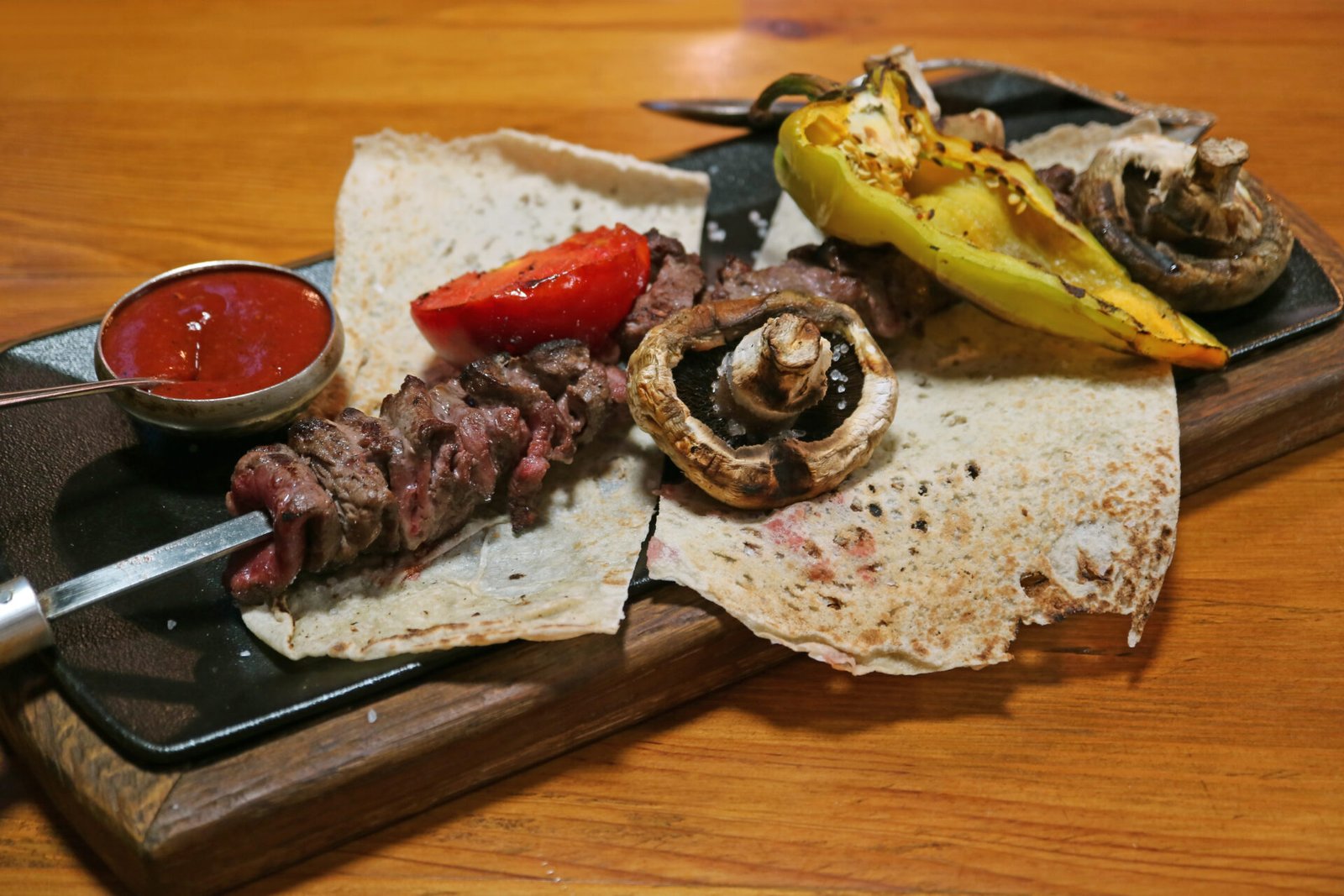
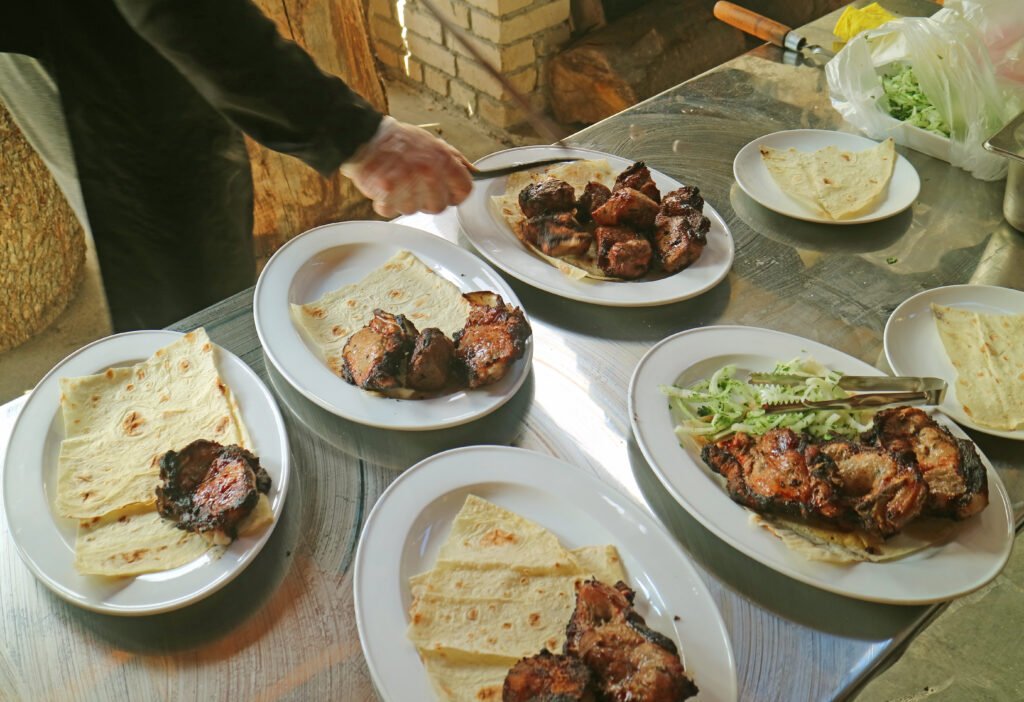
The word means grilled, and it covers everything that goes over wood. Pork loin and ribs are the most common, lamb is the celebration version, and both are usually marinated simply with onion, salt and pepper. It is cooked outside, almost always by a man, almost always with an argument about how it should be done.
Order it with khorovats banjaregheni, grilled aubergine, pepper and tomato, which are then peeled and chopped into a smoky salad. That combination with lavash, fresh tarragon, spring onion and a bottle of Areni Noir is the single best meal in the country and it costs very little.
Dolma, and the vegan version nobody mentions
Dolma, called tolma here, means anything wrapped or stuffed. The classic is minced lamb and beef with rice and herbs in young grape leaves, eaten with garlic matsun, the local yoghurt. In summer you also get vegetable dolma: tomatoes, peppers and aubergines stuffed and baked together.
The one to seek out is pasuts tolma, the Lenten version, made with beans, lentils, chickpeas and cracked wheat rolled into sauerkraut cabbage leaves. It is entirely vegan, served cold or warm, sour and deeply savoury, and it is better than it sounds by some distance.
Soups worth ordering
Spas
A soup of matsun, wheat grains, egg and herbs, served hot in winter and cold in summer. Sour, comforting, faintly like a cross between a yoghurt soup and a broth. Ask for extra dried mint.
Khash
Armenia’s most extreme piece of food culture. A clear broth of cow’s feet, cooked all night, eaten at dawn in deep winter with raw garlic, dried lavash crumbled into it and shots of vodka. There is no salt in the pot; you salt your own bowl. It is a social ritual as much as a meal and you should only try it if invited by someone who takes it seriously.
Others
Lentil soup, bean soup, and kufta in broth all appear on everyday menus and are usually good.
Harissa and ghapama, the ceremony dishes
Harissa is wheat and chicken cooked and beaten for hours into something between a porridge and a pulled meat, finished with melted butter. It is plain, filling and emotionally loaded: it is cooked communally in huge pots for church feasts and it carries memory of the 1915 genocide and the survival of Musa Dagh. Order it once and understand it rather than judge it.
Ghapama is a whole pumpkin hollowed out, filled with rice, dried apricots, raisins, prunes, walnuts, honey and butter, baked until the shell is soft and then cut open at the table. It appears in autumn and at New Year, there is a folk song about it, and most restaurants need a day’s notice.
Cheese, dairy and the market
- Chechil, the salty string cheese pulled into braids and often smoked.
- Lori, a firm, mild everyday cheese.
- Motal, sharp and crumbly, aged with mountain herbs in a clay pot or a skin.
- Matsun, the local yoghurt, thicker and sourer than what you will know from home, used in soup, in sauce and drunk as tan with salt and water.
The place to meet all of these is GUM Market in Yerevan, a covered hall of dried fruit pyramids, cheese counters, spices, pickles and walnut sujukh. Everyone offers samples and nobody expects you to buy from the first stall. Bring cash and an appetite. It fits neatly into a morning in the centre, and our Yerevan walking tour passes through the food streets around it.
Fruit, apricots and pomegranates
The apricot is the national fruit and its Latin name, Prunus armeniaca, tells you where Europe thinks it came from. Armenian apricots ripen from late June into July and taste like a different species to the ones sold in supermarkets: dense, perfumed, almost sticky. If you are here in the season, buy them by the kilo from a roadside table.
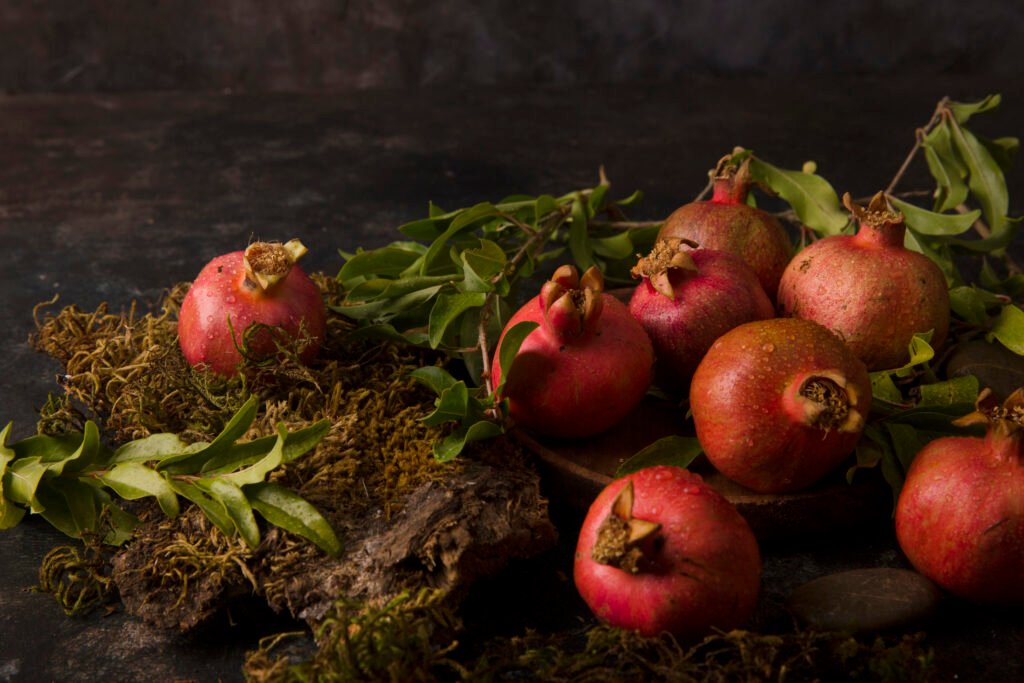
Pomegranates arrive in October and November, and their juice is everywhere all year. Peaches, figs, mulberries, cornelian cherries and grapes fill the summer. Dried fruit is a serious craft here, especially the sour plum and the apricot stuffed with walnut.
Sweets and coffee
Gata is the one to try first: a sweet bread with a buttery flour and sugar filling, made differently in every region, best bought from the women selling it at Garni or on mountain passes. Pakhlava here is walnut heavy and less syrupy than the Turkish or Greek versions. Sujukh is a string of walnuts dipped repeatedly in thickened grape must until it forms a dense candle, sold in every market.
Coffee is soorj, ground to powder and brewed in a small pot called a jazve, served in a tiny cup with the grounds settling at the bottom. Order it without sugar if you want it plain, because sweet is often the default. Someone will offer to read your cup when you turn it over. Yerevan also has a serious modern coffee scene, covered in our guide to Yerevan cafes and nightlife.
Eating well without meat
Armenia is easier than expected. The church keeps long fasting periods during which observant families eat no animal products at all, so a whole vegan repertoire exists and restaurants understand the concept. Look for pasuts tolma, lentil and bean soups, aveluk salad made from dried wild sorrel with walnuts, grilled vegetables, mushroom dishes, herb pies and zhingyalov hats, a thin flatbread packed with up to twenty wild greens that comes from Karabakh and is now sold all over Yerevan. The useful word is busakerakan.
Where to eat
- Yerevan has everything from old school tavern style places around the centre to modern kitchens reworking village recipes, plus Georgian, Iranian, Lebanese and Syrian Armenian restaurants that are part of the city’s fabric.
- Roadside khorovats along the highways south and north. Look for parked cars and smoke. These are often the best meals of a trip.
- Village guesthouses, where dinner is whatever the garden produced. In Dilijan, Tatev and the Vayots Dzor villages this is the standard and it is excellent.
- Wineries, most of which will cook with notice. See our Armenian wine guide and the Areni wine region for the pairings.
Practical notes
Portions are large and starters arrive as a table full of small plates, so order less than you think. Service charge is sometimes included, otherwise ten percent is a good tip. Tap water is safe in Yerevan and the mountain spring fountains, called pulpulak, are free and drinkable. Dinner starts late, and refusing a third helping at someone’s home takes three attempts, which is explained in our notes on Armenian culture and etiquette. For overall budgeting see Armenia travel costs, and for getting out to the village tables, day trips from Yerevan.
Half of what we do is knowing whose grandmother makes the best gata and which roadside grill is worth the stop. If you want your Armenia with the food built in, look at our tours or write and tell us how you like to eat.
Frequently asked questions
What is the national dish of Armenia?
Most Armenians would say khorovats, meat grilled over vine or fruit wood, usually pork or lamb, cooked outdoors and eaten with grilled vegetables and lavash. Dolma and harissa carry more ceremonial weight, but khorovats is what a family cooks when something good has happened. It is a method and an occasion as much as a recipe.
Is Armenia good for vegetarians?
Better than its grilled meat reputation suggests. The Armenian Apostolic Church keeps long fasting periods, so there is a whole vegan tradition built in: pasuts dolma with beans and lentils, lentil and bean soups, aveluk salad from wild sorrel, grilled vegetables, herb dishes and the famous zhingyalov hats stuffed with twenty kinds of greens. Say busakerakan, meaning vegetarian, and you will be understood.
What does a meal cost in Armenia?
In 2026 a main course in a mid range Yerevan restaurant runs roughly 2,500 to 6,000 dram, about 6 to 14 euros. A full khorovats spread for two with wine lands nearer 25 to 40 euros. Bakeries, street lahmajo and market food cost a couple of euros. Tipping is not obligatory; ten percent is generous and always welcome.
Is lavash really UNESCO listed?
Yes. In 2014 UNESCO inscribed lavash, its preparation, meaning and appearance as an expression of culture in Armenia, on the Representative List of the Intangible Cultural Heritage of Humanity. The listing is about the whole practice: the women who work in pairs, the tonir clay oven sunk into the ground, and the role the bread plays at weddings and funerals.