A southern Armenia road trip takes you into Syunik, the long mountainous tail of the country between Yerevan and Iran. In three to five days you can drive the M2 past Zorats Karer to Goris, walk into the cave village of Khndzoresk, ride the Wings of Tatev over the Vorotan gorge and, if you keep going, cross the passes to Kapan and Meghri.
| Quick facts | Detail |
|---|---|
| Yerevan to Goris | about 250 km, 4 to 4.5 hours on the M2 |
| Goris to Kapan | about 65 km but 1.5 hours, constant hairpins |
| Kapan to Meghri | about 75 km, 2 hours over a 2,500 m pass |
| Best season | May to October; passes can close briefly in winter |
| Minimum time | 3 days, 5 days if you want Meghri |
| Car | sedan fine for main sights, higher clearance for gorge tracks |
| Fuel | stations in Sisian, Goris, Kapan, Meghri; fill up before mountain sections |
Why Syunik is worth the drive
Most visitors to Armenia stay inside a triangle two hours wide around Yerevan. Syunik is what happens when you break out of it. The plateau falls away into gorges a kilometre deep, villages cling to ledges, monasteries perch where nobody sane would build, and the air smells of juniper and hot stone. It is also the least visited part of the country, which means guesthouse owners still treat you as a guest rather than a booking reference.
The trade off is distance. This is a driving trip, and the road does not hurry. Plan generous days, do not try to reach Meghri and back in a weekend, and accept that Armenian mountain roads convert kilometres into hours at a rate that surprises everyone the first time.
Day one: Yerevan to Goris, with stops
The M2 south is a good road by regional standards, two lanes, mostly smooth, with three sections of climbing. Break the drive properly rather than pushing through.
Areni and Noravank
Ninety minutes out of Yerevan you reach Areni, the wine village, and the red canyon that hides Noravank monastery. Even if you have seen it before, the turn is worth taking for the light. Our Areni and Noravank guide has the detail, and the same stretch forms our Khor Virap, Areni and Noravank tour if you would rather be driven.
Zorats Karer (Karahunj)
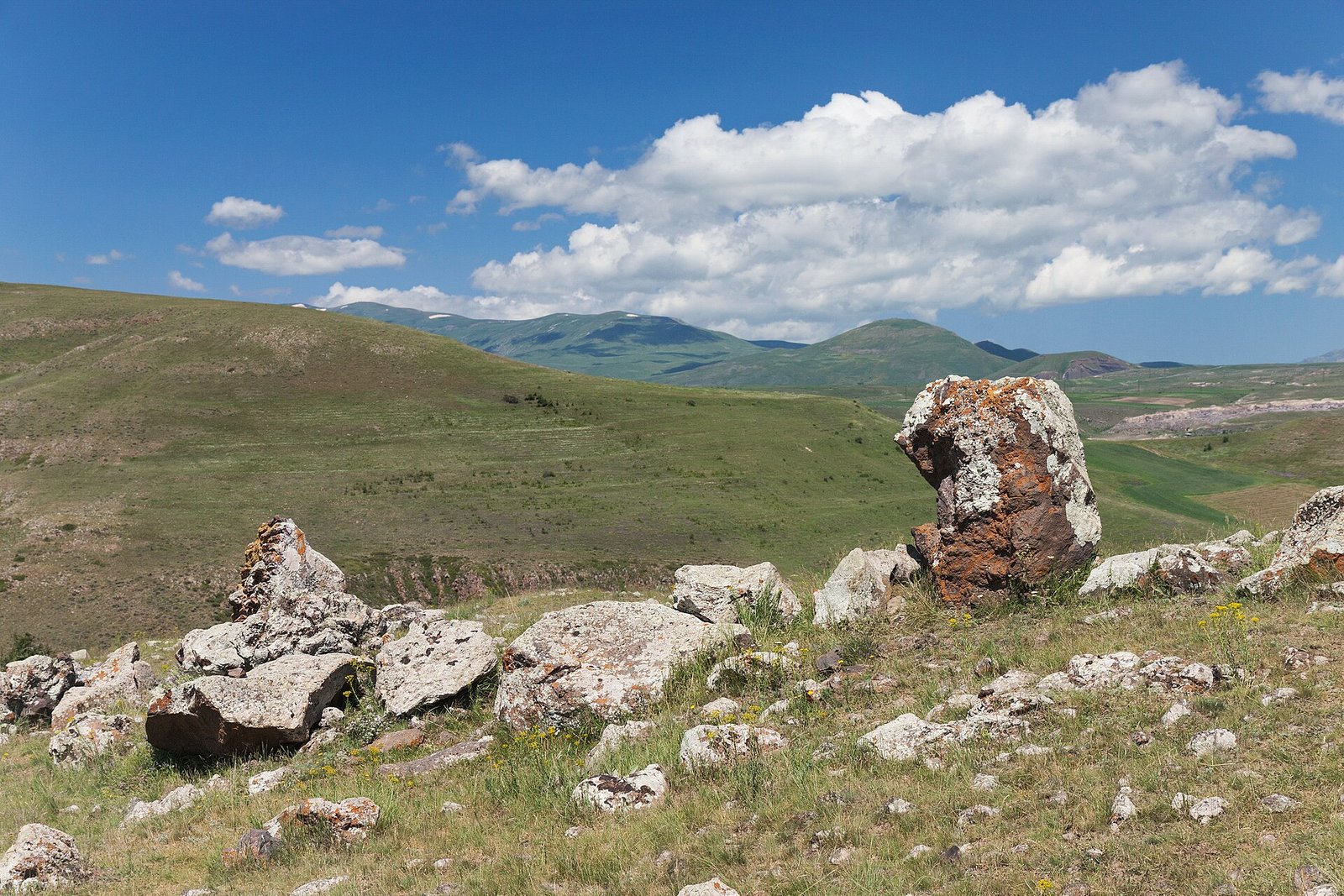
Just off the highway near Sisian stands a field of roughly 220 upright basalt stones, many pierced with smooth round holes. Locals call it Karahunj, guidebooks call it the Armenian Stonehenge, and archaeologists argue about all of it. The astronomical claims are contested and the dating is uncertain, so treat the more confident signage with mild scepticism. As a place it is still remarkable: wind, grass, dark stones, no fence, almost nobody there.
Shaki waterfall
A short detour from Sisian, an 18 m fall that runs strongly in spring and early summer and can be reduced to a trickle later in the year because water is diverted for a small hydro plant. Worth ten minutes in June, skippable in September.
Goris: the base for everything
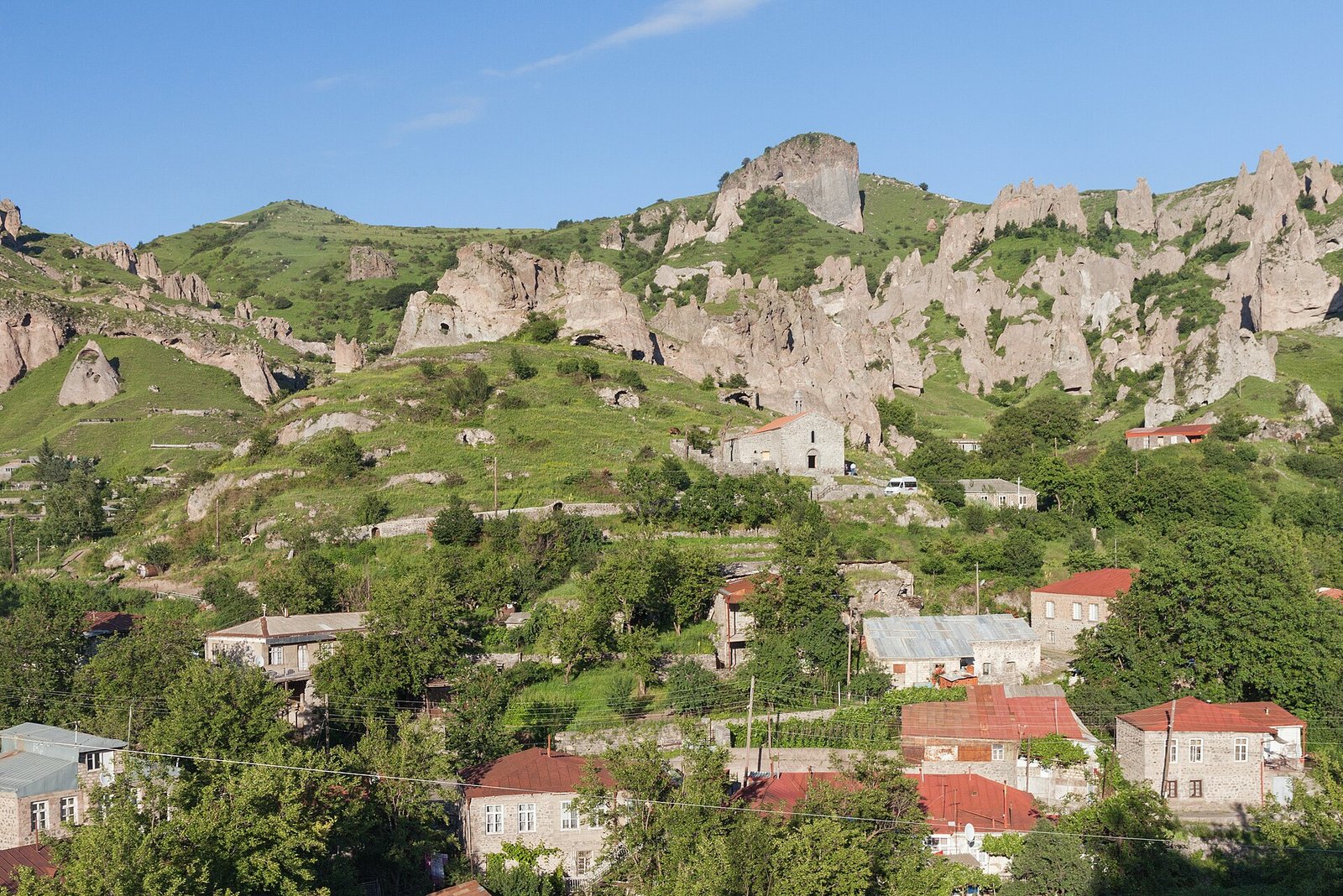
Goris is the most liveable town in the south. It was laid out in the nineteenth century on a grid, which is unusual in Armenia, and it sits in a bowl surrounded by eroded rock pinnacles that locals call the stone forest. The old houses are cut stone with wooden balconies, there are mulberry trees along the streets, and the local vodka is made from those mulberries and will remove the lining of your throat if you are not careful.
Practically, Goris has the best choice of guesthouses in Syunik, several good restaurants, ATMs and fuel. Sleep here two nights and drive out and back rather than moving hotels every day.
Khndzoresk: the cave village
Eight kilometres east of Goris, the old village of Khndzoresk is dug into the soft rock of a gorge: hundreds of caves on several levels, some still used as sheds, connected by paths and by a swinging footbridge about 160 m long built in 2012. People lived here until the 1950s, when the Soviet authorities moved everyone to the new village on the plateau.
Two things to know. First, it is steep: the descent from the car park to the bridge and back is a real climb of around 200 m, so go in the cool part of the day and take water. Second, the gorge is quiet in the early morning and busy with tour buses from eleven. Go at eight and you will have it more or less to yourself.
Tatev and the Wings of Tatev
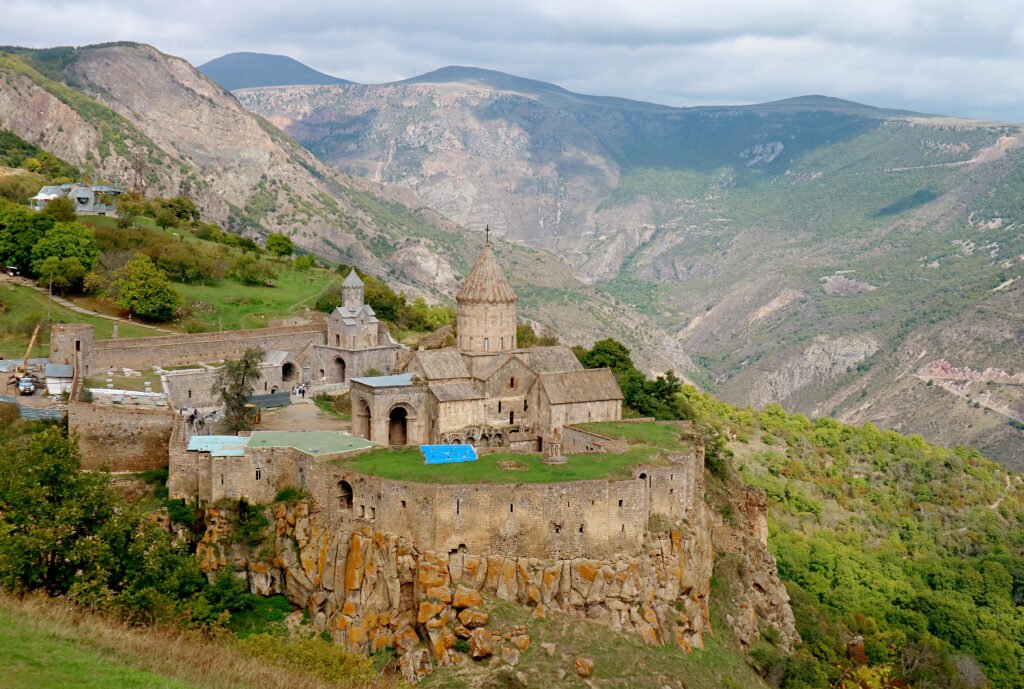
Tatev monastery, founded in the ninth century, sits on a promontory above the Vorotan gorge and was once a university with hundreds of monks and scribes. It is the single most impressive building in southern Armenia, and the way you get there is almost as memorable.
The Wings of Tatev cable car runs 5.7 km from Halidzor across the gorge and holds the record as the world’s longest reversible aerial tramway. The crossing takes around 12 minutes and the middle of it, suspended several hundred metres above the river, silences even loud groups. Expect roughly 8 to 12 euros return per adult in 2026 and check the operating days, because it closes for maintenance for a period each year, usually outside high season.
The alternative is the old road down into the gorge and up the other side: about 40 minutes of serious hairpins each way, rewarding if you like driving and pointless if you do not. On the way, the Devil’s Bridge, a natural travertine arch over the Vorotan with warm mineral pools underneath, is a proper stop. Our dedicated Tatev and Wings of Tatev guide covers timings, and the easy version is our two day Tatev tour.
Kapan and Mount Khustup
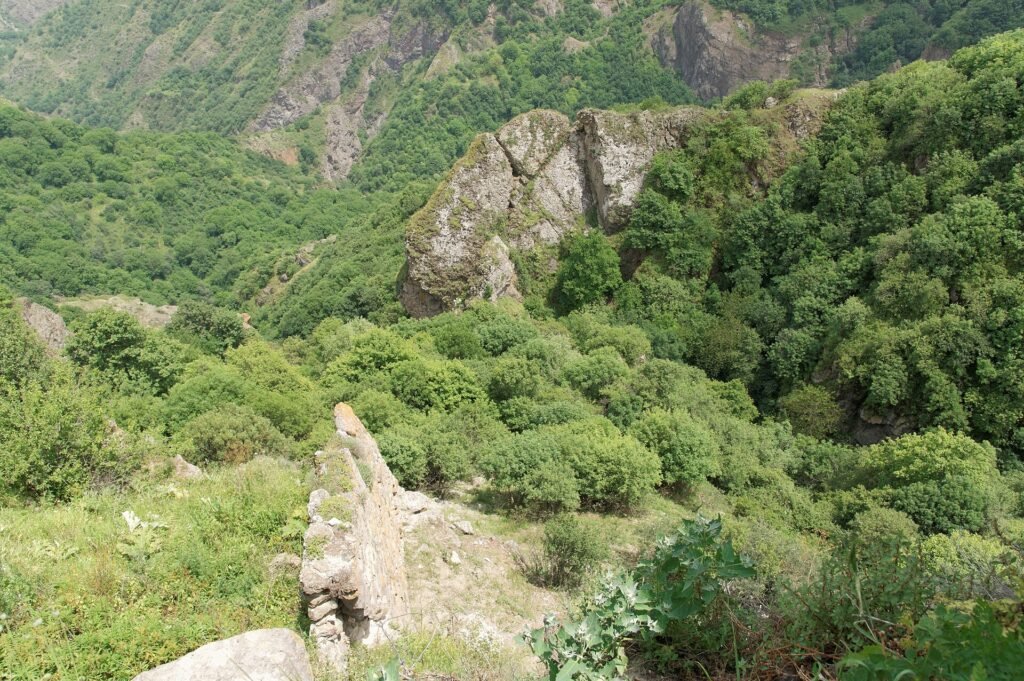
South of Goris the road stops being a highway and becomes a mountain road in earnest. Kapan, the largest town in Syunik, lies in a narrow valley under Mount Khustup, a 3,201 m pyramid that dominates every view in town. Kapan is a working mining town rather than a pretty one, but the setting is spectacular and it is the right base for the deep south.
From here you can walk into the Zangezur mountains, visit Vahanavank monastery just outside town, or take the small ropeway up the valley side. Serious walkers climb Khustup itself, which is a full eight to ten hour day; we describe it in our guide to hiking in Armenia.
Meghri and the far south
Meghri sits at 600 m, more than a thousand metres lower than Kapan, in a pocket of warm air where pomegranates, figs and persimmons grow. Getting there means the Meghri pass at around 2,500 m, a long climb and a longer descent with views over the Araks valley and into Iran.
The old town of Meghri is genuinely lovely: flat roofed houses, narrow lanes, and three seventeenth century churches with painted interiors, of which Surb Hovhannes is the finest. Almost no foreign visitors get this far. If you have five days, spend one of them here rather than adding another monastery further north.
Roads, borders and honest advice
The M2 is the artery of southern Armenia and carries freight to and from Iran every day. It is well used and ordinary travellers drive it all season. Some sections in the southeast run close to the border, and the practical situation on individual stretches has changed more than once in recent years. Alternative bypass roads have been built and improved.
What that means for you is simple and not dramatic: ask locally on the morning you drive. Your guesthouse in Goris or Kapan, a local driver, or the tourist information office will tell you exactly which road people are using that week. Do not rely on an article written months earlier, including this one, for that specific question. Everything else in this guide, the sights, the distances, the seasons, is stable.
Other practical points:
- Fuel up in Sisian, Goris or Kapan. Gaps between stations in the mountains are long.
- Mobile coverage drops in the gorges. Download offline maps.
- Winter driving over the passes needs winter tyres and flexibility; snow can close a pass for a day.
- Livestock on the road is normal. Drive as if a cow is around every blind bend, because eventually there is.
- Car rental and transport basics are in our getting around Armenia guide.
We run this route regularly with our own drivers who grew up in Syunik and know which road is open today. If you would rather look out of the window than at hairpins, see our tours and we will build the southern leg around your dates.
A five day itinerary that works
- Day 1. Yerevan to Goris via Areni, Noravank and Zorats Karer. Night in Goris.
- Day 2. Early Khndzoresk, afternoon Tatev by cable car, Devil’s Bridge on the way back. Night in Goris.
- Day 3. Goris to Kapan, Vahanavank, afternoon walk under Khustup. Night in Kapan.
- Day 4. Kapan to Meghri over the pass, old town and churches. Night in Meghri.
- Day 5. Long drive back to Yerevan, or north to Lake Sevan if you are continuing a loop.
If you only have three days, cut Kapan and Meghri and give the extra time to Tatev and Khndzoresk rather than rushing all five stops. Fitting this into a longer trip is covered in our ten day Armenia itinerary.
Where to eat and sleep
Expect family run guesthouses rather than hotels, at roughly 25 to 50 euros for a double room with breakfast in 2026, a little more for the few smarter places in Goris. Dinner at the guesthouse is usually the best meal available and costs around 8 to 15 euros a head, often including more food than four people could eat. Say yes to it. In Syunik the food comes from the garden behind the house, and the conversation that arrives with it is the reason to drive this far south.
Frequently asked questions
How many days do you need for a southern Armenia road trip?
Three days gets you to Goris, Khndzoresk and Tatev at a civilised pace. Five days lets you add Kapan and the Meghri pass without driving in the dark. Anything shorter than three days turns into a marathon on the M2, because Yerevan to Goris alone is four to four and a half hours each way.
What car do you need for Syunik?
A normal sedan handles the main M2 highway, Goris, Tatev and the ropeway. You want higher clearance for the old Tatev gorge road, the tracks around Khndzoresk and any village detour after rain. Four wheel drive is genuinely useful only if you plan rough side roads or travel between November and March.
Is it safe to drive near the border in Syunik?
The main route is used daily by Armenian drivers and by freight heading to Iran, and tourists travel it routinely. Some stretches run close to the border and conditions there can change, so ask locally the morning you drive rather than relying on a blog post. Your guesthouse, a local driver or the tourist office in Goris or Kapan will tell you what people are doing that week.
Can you do southern Armenia without your own car?
Yes, but it costs you time. Marshrutkas run Yerevan to Goris and Kapan daily, usually in the morning, and shared taxis fill the gaps. Once in Goris you will still need a taxi for Khndzoresk and Tatev, which is straightforward and inexpensive. Most people either rent a car or hire a driver for the southern leg.