The oldest archaeological finds in Armenia go back hundreds of thousands of years, long before churches and fortresses: stone tools in the Hrazdan valley, cave camps in the south, a Copper Age winery, a leather shoe. The Areni-1 winery is older than the stone circle of Stonehenge. Below we separate what scientists have actually dated from what is repeated in brochures, and tell you honestly which of it you can see on a trip.
| Question | Short answer |
|---|---|
| Oldest dated site? | Nor Geghi 1 in the Hrazdan valley: stone tools between lava layers dated to roughly 325,000 to 350,000 years ago. |
| Oldest winery? | Areni-1 cave: a wine press, vats and jars dated to about 6,100 years ago. The oldest known winery installation, not necessarily the oldest wine. |
| Oldest shoe? | A leather shoe from Areni-1, about 5,500 years old. Its excavators call it the oldest shoe found in Eurasia. |
| Oldest cave camps? | Aghitu-3 near Sisian (about 39,000 to 24,000 years ago) and Lusakert-1 in the Hrazdan valley (about 65,000 to 34,000 years ago). |
| Where can I see finds? | History Museum of Armenia on Republic Square, plus site museums at Shengavit, Erebuni and Metsamor. |
| Can I enter Areni-1? | Listings describe short guided visits with lighting. Hours and fees change, so check locally. |
| Dinosaurs? | No well-known dinosaur finds. Fossils are mostly marine Permian limestones and Ice Age lake deposits. |
| Best way to combine? | Areni-1 fits a day with Noravank and Khor Virap; Erebuni and the museums fit a Yerevan day. |
What is the oldest thing ever found in Armenia?
The oldest securely dated human traces we found cited are stone tools from Nor Geghi 1, a site in the Hrazdan valley just outside Yerevan. Researchers date them to roughly 325,000 years ago. Other Lower Palaeolithic sites exist in the country and their dating is uneven, so we call Nor Geghi 1 a well-dated example, not the single oldest place.
From there the story runs through caves (tens of thousands of years), the first farming villages (around 6,000 BC), the Copper and Bronze Ages (the winery, the shoe, Shengavit, Metsamor, the Lchashen wagons) and finally the Urartian fortress of Erebuni, founded in 782 BC.
What was found at Nor Geghi 1?
The stone tools lie between two lava flows dated to roughly 325,000 and 350,000 years ago. According to the team led by Daniel Adler of the University of Connecticut, published in the journal Science in 2014, the layer contains both older biface (handaxe) technology and the more refined Levallois technology, side by side.
That mattered because Levallois had often been seen as an African invention that spread with migrating populations. Nor Geghi suggests that people in the Caucasus region developed it locally. Chemical analysis also showed that the toolmakers used obsidian from outcrops up to about 75 miles (roughly 120 km) away. The researchers do not name who made the tools, and neither do we.
This is an excavation site, not a visitor attraction, as far as we know. The pleasure here is understanding the landscape, not walking a trail.
Did people live in caves in Armenia?
Yes, and two caves have been studied in detail. Aghitu-3, in the Vorotan gorge near Sisian, was used between about 39,000 and 24,000 years ago according to a 2017 study in the Journal of Human Evolution led by Andrew Kandel. A sewing needle of about 29,000 years is reported from there. Lusakert-1, a rockshelter beside the Hrazdan river in Kotayk, has ash, obsidian and worked bone in layers dated to about 65,000 to 34,000 years ago (Quaternary Environments and Humans, 2025).
Both are research sites. We do not know of regular public access, so do not plan a stop at either without asking the local authorities first. Aghitu-3 is, however, close to Karahunj, which we cover in our guide to Karahunj (Zorats Karer).
What was found in the Areni-1 cave?
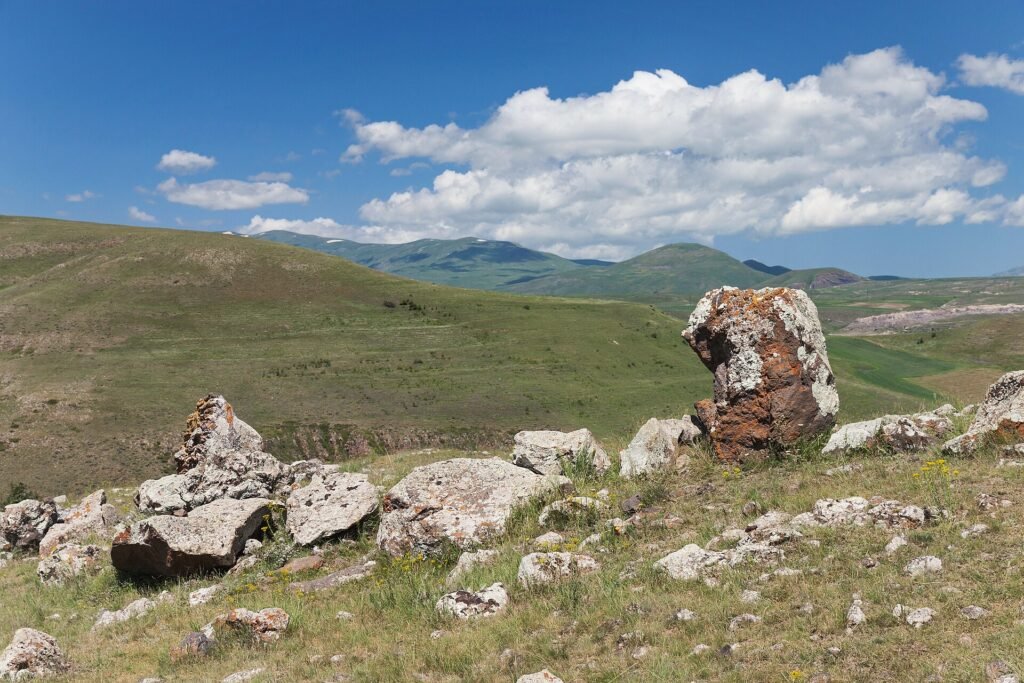
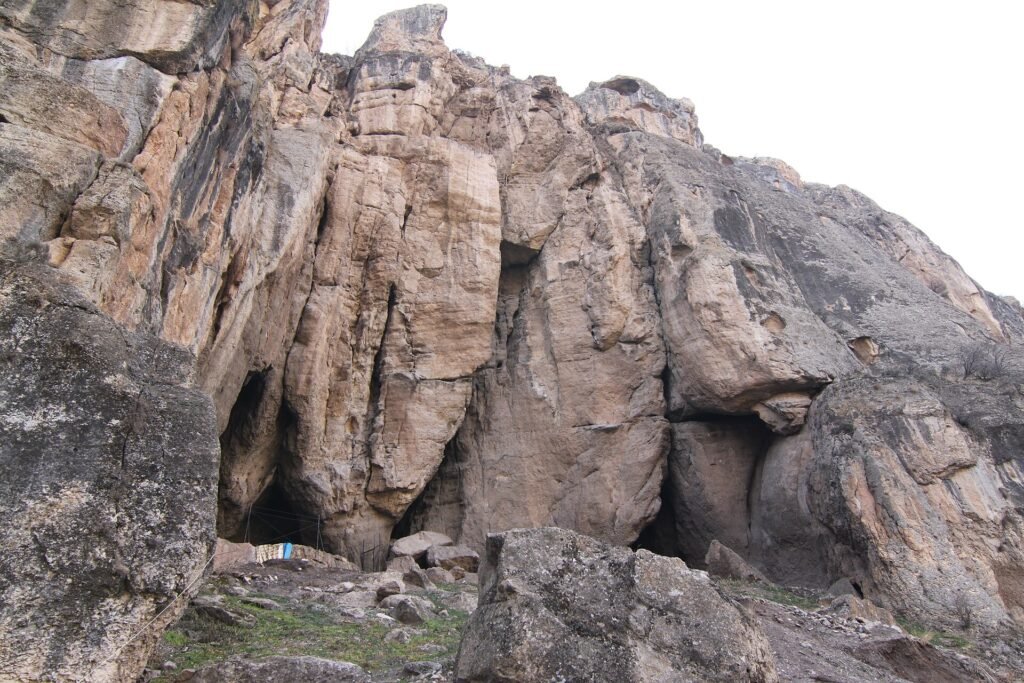
Areni-1 is a karst cave above the Arpa river gorge in Vayots Dzor. Its cool, dry air preserved things that normally rot: reeds, ropes, textiles, wood and leather.
An Armenian-Irish team under Boris Gasparyan began digging in 2007. A UCLA-led study (Hans Barnard and colleagues, Journal of Archaeological Science, 2011) described a wine press, a large fermentation vat, a shallow clay basin for treading grapes, storage jars, cups, and grape skins, seeds and vine remains. Pottery from the site was radiocarbon dated to 4100 to 4000 BC, hence “about 6,100 years old”.
The shoe came from a plastered pit, lying upside down beneath an upturned pot and stuffed with grass. Three leather samples dated it to about 3627 to 3377 BC (PLoS ONE, 2010), so around 5,500 years.
Is Areni-1 really the oldest winery and the oldest shoe?
Handle the word “oldest” with care. The authors of the shoe paper say it is the oldest shoe found in Eurasia, and they add that earlier footwear almost certainly existed; older shoes are known from North America. A 2017 study also reported chemical traces of wine in pottery from sites in Georgia, dated to about 8,000 years ago. So Areni-1 is best described as the oldest known winery installation, with press and vats in place.
It is still exceptional. If you drink the local Areni grape afterwards, our guide to Areni wine and the wider Armenian wine guide explain what to taste.
Can you visit the Areni-1 cave?
Listings show a visitor set-up: a guided walk of about 20 minutes, electric lighting, photos allowed, and a view of the ceramic vats, press and jars. One cave-guide site gave opening as daily 10:00 to 19:00 (2021 data) and an adult ticket of 1,000 AMD (2019 data). Treat both as old information and check locally. The listing also says the cave is not wheelchair accessible, and part of it remains unexplored.
Do not expect the shoe there. It is in the History Museum of Armenia in Yerevan, which reopened a Stone Age exhibition in 2022 with the shoe as a highlight.
Areni sits on the road to Noravank and the Areni wine region, so it combines naturally with our Khor Virap, Areni and Noravank day tour. If you want the cave added to a private day, ask us.
What came after: villages, Shengavit, Metsamor and the Lchashen wagons?
- Aknashen in the Ararat valley: a Neolithic village of the first half of the 6th millennium BC, with a cultural layer almost 5 m thick, excavated by an Armenian-French team.
- Shengavit in Yerevan: a Kura-Araxes settlement of the Early Bronze Age. Use is traced from the late 5th to the early 3rd millennium BC. A small museum on site shows about 1,500 finds, according to Yerevan municipality.
- Metsamor in Armavir province: settled from the mid-4th millennium BC, with a citadel, metalworking and a museum opened in 1968. Claims that it was an observatory are presented as hypotheses.
- Lchashen near Lake Sevan: wooden wagons found in the 1950s when the lake level was lowered, dated to the Late Bronze Age, around the 15th to 14th centuries BC. They are displayed in Yerevan.
Obsidian ties it together. The volcanic highlands hold around 14 known sources, and at Lusakert-1 and Nor Geghi 1 some 93 percent of obsidian artefacts come from one source, Gutansar. Armenian obsidian turns up far from its origin.
Karahunj is often called a 7,500-year-old observatory. That age has not been proven by research, as a 2019 fact-check noted. Our Karahunj article covers it neutrally.
Where does Erebuni fit in?
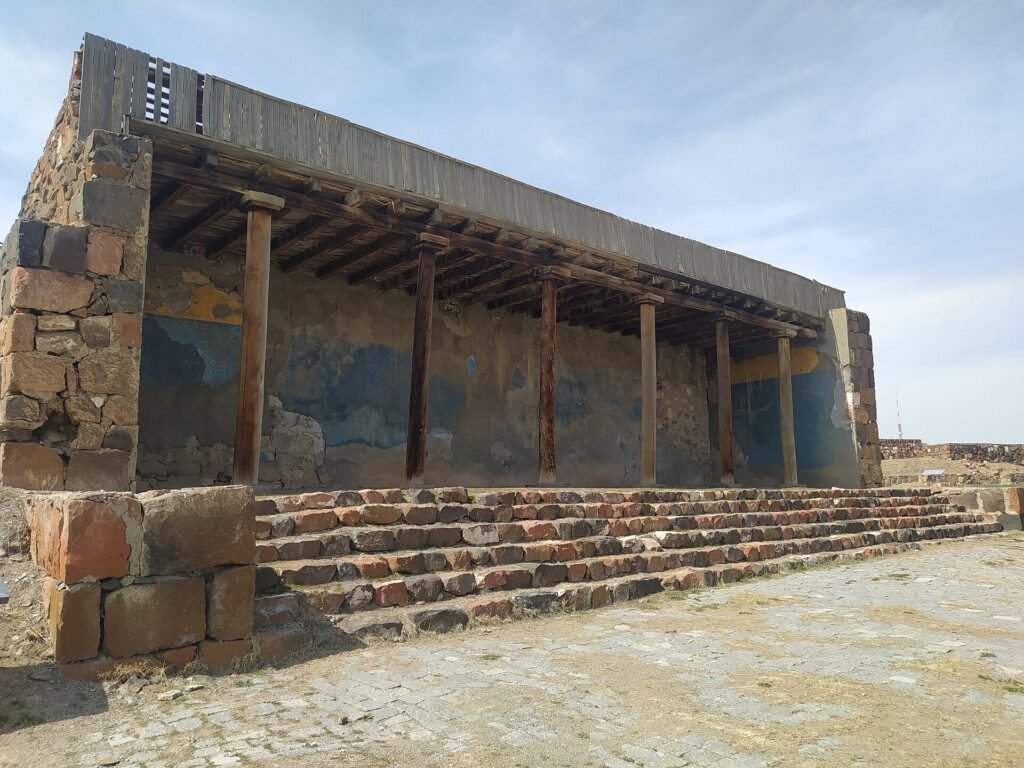
Erebuni is much younger, but it is the one early site in Yerevan itself. King Argishti I of Urartu founded it in 782 BC, and Yerevan marks that year as its founding date. The cuneiform inscription recording the foundation is in the History Museum of Armenia. On Arin Berd hill you see the fortress walls, palace remains and temple foundations, and the Erebuni Museum below shows pottery, helmets and replicas. Listings give hours of roughly Tuesday to Sunday daytime, but check before you go.
What about fossils and dinosaurs?
We could not verify any significant dinosaur finds in Armenia, so we will not suggest any. What the published record does show: marine fossils in Permian limestones in Vayots Dzor (brachiopods, bryozoans, sponges), and Ice Age lake and river deposits in Shirak, northwest Armenia, with pollen, molluscs, fish and small mammals dated roughly 1.5 to 0.7 million years ago (Tesakov and colleagues, 2019).
These are mostly for specialists. If fossils are your main interest, tell us before you book and we will check what is actually on show.
Where can you see all this in Yerevan?
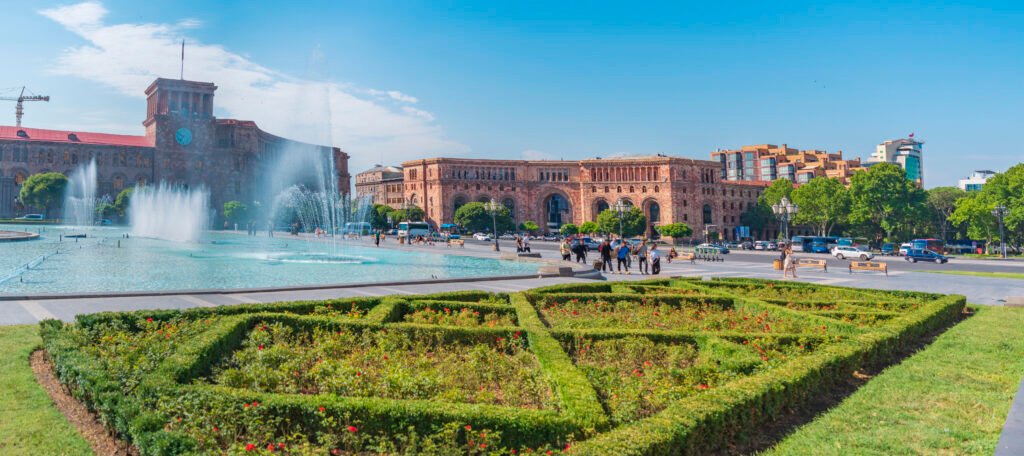
The History Museum of Armenia, 4 Republic Square, is the best single stop. It holds over 400,000 objects, the Stone Age exhibition, Bronze Age material, Urartian finds and the Lchashen wooden wagons in a separate hall. Listings say it is closed on Mondays; check hours. Our Yerevan city walking tour passes close by, and the Yerevan museums guide covers other options.
Who should skip this, and what are the limits?
If you want dramatic ruins, this topic can disappoint. Nor Geghi, Lusakert and Aghitu are science sites; Areni-1 is small, and the famous shoe is in a museum. Dates change as dating improves, and “oldest” claims are often revised.
Treat our opening hours and prices as unverified. We can build a trip around the parts that truly reward a visit; see our tours or tell us your interests via the contact page, and for the south look at our southern Armenia road trip.
We run a Khor Virap, Areni wine and Noravank day tour through the Areni valley, and a Yerevan walking tour near the museums. For a private day built around archaeology, see our tours or write to us.
Frequently asked questions
What is the oldest archaeological site in Armenia?
Nor Geghi 1 in the Hrazdan valley is a well-dated example, with stone tools about 325,000 years old. Other early sites exist with less certain dating.
How old is the Areni-1 winery?
It is dated to about 6,100 years ago, based on radiocarbon dating of pottery. It is described as the oldest known winery installation.
Where is the Areni shoe now?
The roughly 5,500-year-old leather shoe is kept in the History Museum of Armenia in Yerevan, not in the cave.
Can tourists enter the Areni-1 cave?
Listings describe guided visits of about 20 minutes, but hours and fees change. Check locally before you go.
Are there dinosaur fossils in Armenia?
We found no verified significant dinosaur finds. Known fossils are mainly Permian marine fossils and Ice Age deposits.