The best things to do in Yerevan fit comfortably into two or three unhurried days: climb the Cascade at sunrise, read thousand year old manuscripts at the Matenadaran, haggle over old cameras at Vernissage, then sit with a coffee on Saryan Street while the city wakes up. Armenia’s capital is small, pink stoned and genuinely walkable, and it rewards travellers who slow down.
| Quick facts | Yerevan |
|---|---|
| Time needed | 2 to 3 days in the city, more if you use it as a base |
| Best months | May to June, September to October |
| Getting around | Walking, metro (a flat fare of a little over 0.20 EUR in 2026), taxi apps |
| Currency | Armenian dram (AMD), roughly 420 to 450 to 1 EUR |
| Airport | Zvartnots (EVN), 12 km west, 20 to 30 minutes by car |
| Languages | Armenian, Russian widely spoken, English common in the centre |
Getting your bearings in a city built on circles
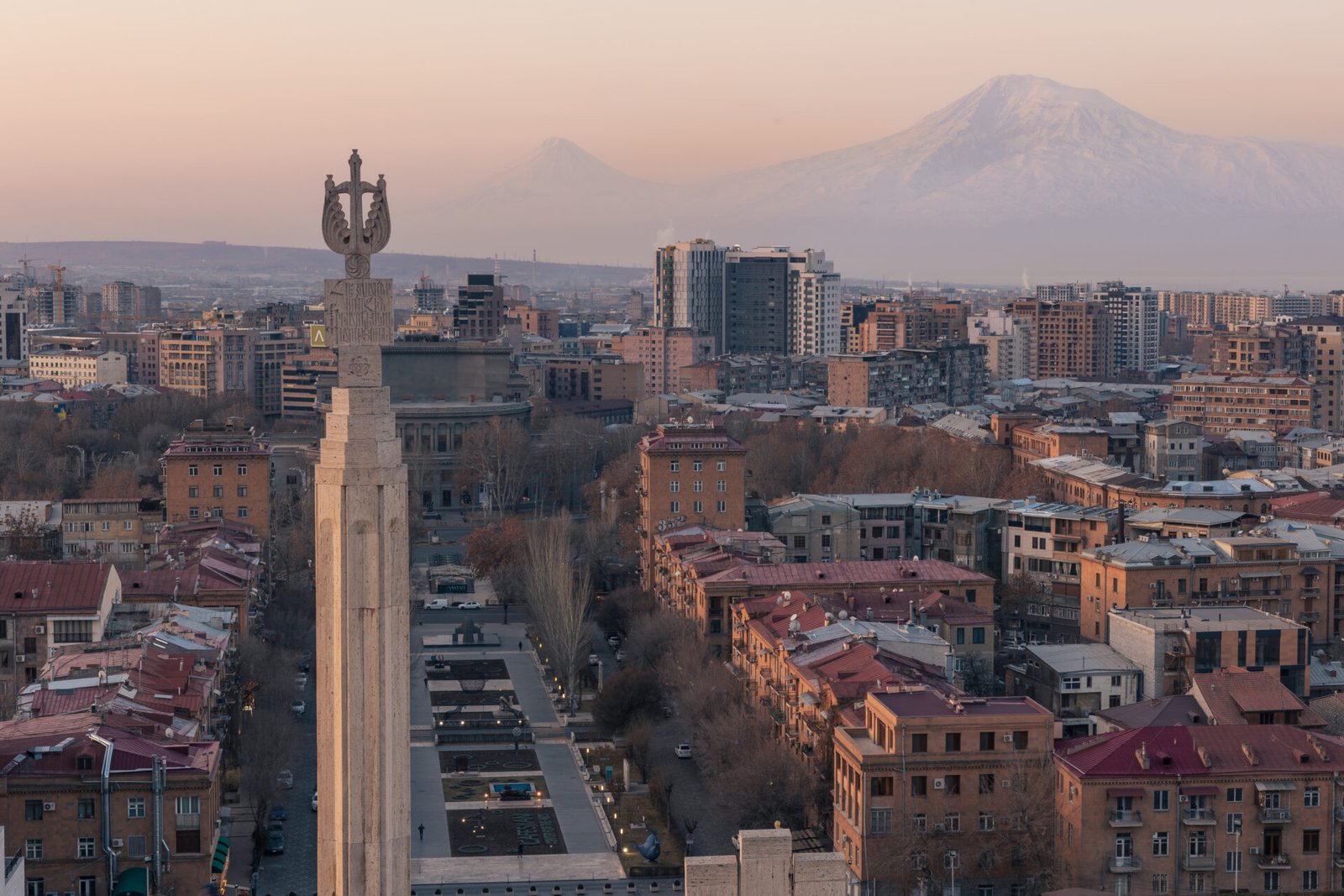
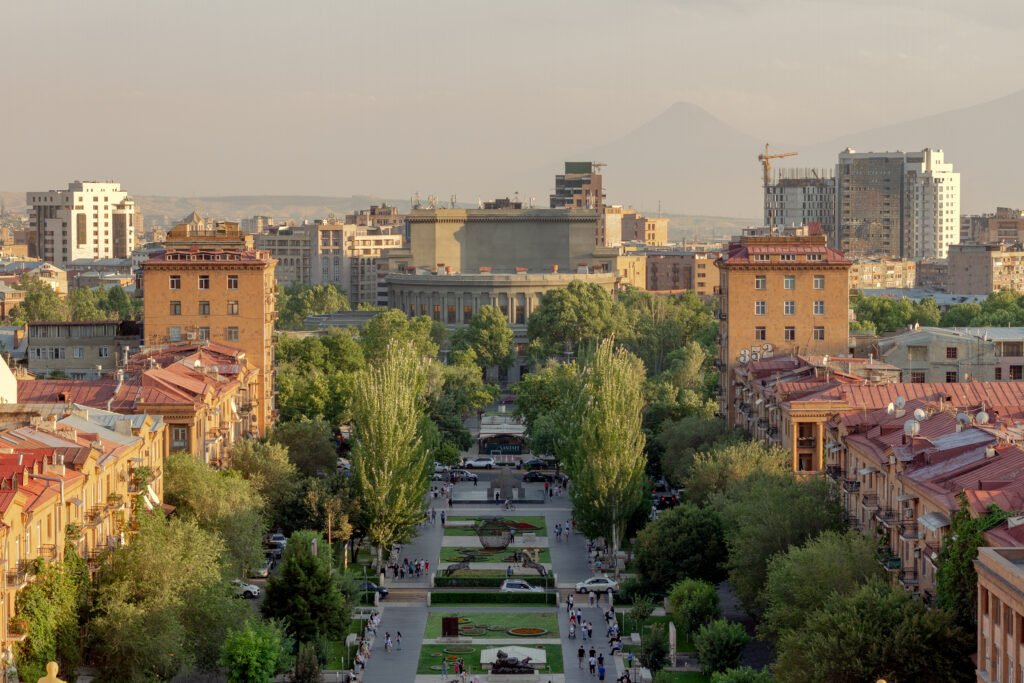
Yerevan was rebuilt in the 1920s and 1930s to a plan by the architect Alexander Tamanian, and once you understand his plan the city stops being confusing. Republic Square sits at the heart. A ring boulevard loops around the centre. The Cascade climbs north out of that ring toward the Victory Park hill. Almost everything a first time visitor wants to see sits inside or just outside that ring, in the district called Kentron.
The stone is the first thing people notice. Yerevan is built largely from local tuff, a volcanic rock that comes in pink, apricot and occasionally black, and the whole centre changes colour through the day. At 7am it is pale rose. By late afternoon it glows properly orange. This is not a detail you plan around, but it is the reason so many travellers end up walking the same streets three times.
If it is your first trip to the country, our Armenia travel guide covers the wider picture: routes, seasons, budgets and how the regions fit together.
Climb the Cascade at the right hour
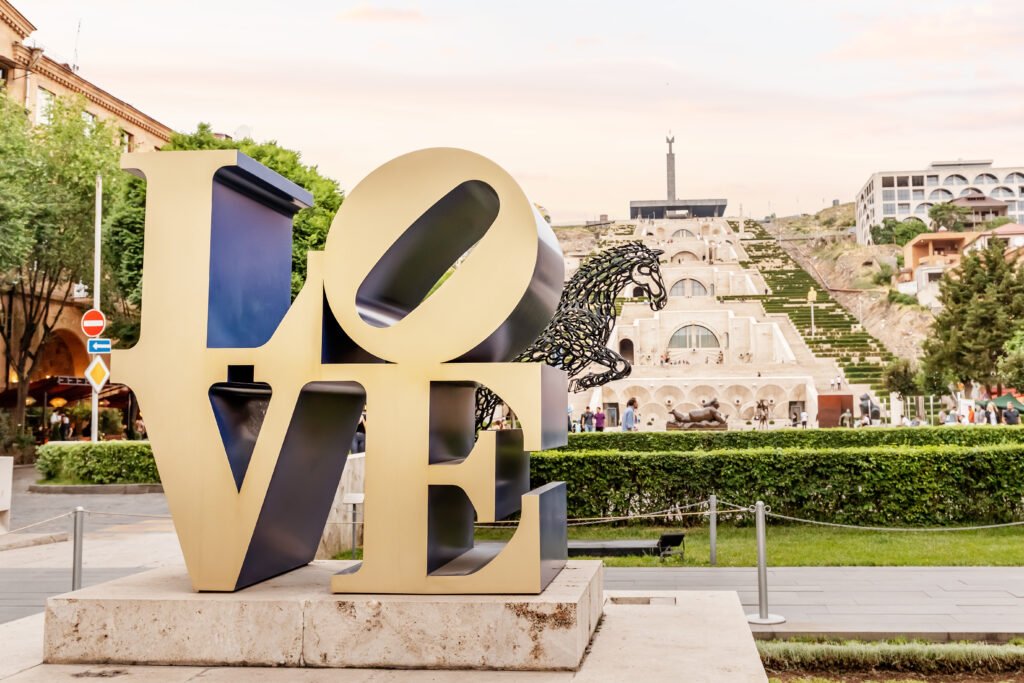
The Cascade is a giant limestone stairway of 572 steps rising from Tamanian Street up the hillside, built as a Soviet era monument and finished, in part, decades later. It works as three things at once: a sculpture park, a viewpoint and the city’s favourite meeting place.
At the bottom sits the Cafesjian Center for the Arts sculpture garden, free and open air, with Botero’s fat bronze cat and Lynn Chadwick’s angular figures scattered among the fountains. Inside the structure there are escalators, also free, with contemporary art on each landing. Most travellers take the escalators up and walk down, which is the sensible order.
Go early. At sunrise you get the terraces almost to yourself, and on a clear morning Mount Ararat sits on the southern horizon looking impossibly close, which it is: about 60 kilometres away, across a closed border in Turkey. The mountain hides behind haze most summer afternoons, so morning is not just prettier, it is more reliable.
Republic Square and the centre
Republic Square is an oval of Tamanian’s tuff buildings around a central fountain, and it is the closest thing Yerevan has to a living room. The History Museum and National Gallery occupy the eastern side. Government buildings, the post office and the Marriott take the rest.
The singing fountains run on summer evenings, usually from around 9pm, with music and coloured light, and half the city turns up to watch. It is unashamedly sentimental and completely worth twenty minutes of your evening.
From the square, three walks branch out. North along Abovyan Street takes you past nineteenth century facades toward the Cascade. Northwest along Amiryan gets you to the Opera House and the park around it. West through the small streets brings you to the covered market and, eventually, to Kond.
The Matenadaran: Armenia’s manuscript library
The Matenadaran sits at the top of Mashtots Avenue, a stern basalt building with a statue of Mesrop Mashtots, the monk who invented the Armenian alphabet in 405 AD, out front. Inside are more than 17,000 manuscripts and many thousands of fragments, one of the world’s great collections of medieval writing.
The exhibition halls show a rotating selection: illuminated gospels with pigments made from ground insects and lapis, medical treatises, star charts, and the Msho Charentir, a gospel so heavy that two women carried it to safety in halves during the genocide, each taking one part. Allow ninety minutes. The captions are good, but a guided visit brings out the stories that the glass cases cannot.
This is where Yerevan stops being a pleasant Caucasus capital and starts explaining itself. Armenia’s relationship with its alphabet and its written word is not academic. It is the reason a small, repeatedly invaded nation still exists.
Vernissage, GUM Market and where the city shops
Vernissage
Vernissage is an open air market that runs alongside Hanrapetutyan Street, busiest on Saturdays and Sundays, quieter but still open on some weekdays. It sells carpets, khachkar carvings in miniature, obareh woodwork, silver, Soviet cameras, military badges, chess sets, old vinyl and paintings of Ararat in every possible weather. Prices are negotiable, politely and without drama. Start by asking, not by offering half.
Good buys: hand knotted rugs from Artsakh and Syunik, apricot wood carvings, and coffee sets. Things to be careful with: anything claiming to be genuinely antique, and anything you would need an export permit for.
GUM Market and Pak Shuka
GUM Market on Movses Khorenatsi Street is the food market, and it is the one to visit if you want to understand Armenian cooking before you eat it. Walls of dried fruit, mountains of sujukh (walnut strings dipped in grape must), barrels of pickles, sheep cheese, mulberry vodka in unlabelled bottles. Vendors will hand you things to taste and will not let you leave without trying the dried peaches. Bring small notes.
The covered market on Mashtots Avenue, known as Pak Shuka, is architecturally lovely but has become part shopping centre. Still worth a look for the arched interior.
If you want to go deeper on what you are tasting, read our guide to Armenian food before you shop.
Tsitsernakaberd: the Armenian Genocide Memorial
On a hill west of the centre stands a circle of twelve inclined basalt slabs around an eternal flame, and a 44 metre stele split in two. This is the memorial to the 1.5 million Armenians killed in the Ottoman Empire from 1915. The museum built into the hillside is sober, well curated and hard, and it takes about an hour.
Armenians visit constantly, often bringing flowers. If you visit on 24 April, the day of commemoration, you will see hundreds of thousands walk up the hill through the night. On any other day it is quiet, and the walk through the pine trees planted by visiting heads of state is oddly peaceful.
Take a taxi up, then walk back down through the Hrazdan gorge or across to the Victory Park side. Entrance to the museum is free.
The Blue Mosque, Kond and the older city
The Blue Mosque on Mashtots Avenue is the only working mosque in Armenia, built in the 1760s when Yerevan was a Persian khanate capital. Its courtyard, with a pool, fruit trees and turquoise tiled dome, is a genuinely restful pocket in the middle of a busy avenue. Visitors are welcome outside prayer times; dress modestly and take your shoes off inside the prayer hall.
Just north and uphill from there is Kond, the oldest surviving neighbourhood in the city, a maze of low houses, hand painted walls and stairways that was somehow never flattened by the Soviet planners. It is scruffy, lived in and full of murals. Walk through respectfully. People live here, and it is not an attraction.
Parks, coffee and the evening rhythm
Yerevan’s real life happens outdoors from April to October. The Opera House park, Lovers’ Park on Baghramyan, the Circular Park along the old city wall line and the Swan Lake area all fill up from about six in the evening with families, chess players and teenagers.
Coffee is taken seriously. Saryan Street, sometimes called wine street, is the obvious place to start, and Tumanyan and Pushkin streets are full of small roasteries and bakeries. Order surj, the strong unfiltered Armenian coffee served in a small cup with the grounds settling at the bottom, and do not drink the last centimetre. We have written a full guide to Yerevan cafés, nightlife and neighbourhoods if you want addresses and districts.
Museums worth your time
- History Museum of Armenia, Republic Square. The 5,500 year old leather shoe from Areni cave, bronze age chariots, and a clear run through the whole national story. Two hours.
- Sergei Parajanov Museum, above the Hrazdan gorge. The house museum of the surrealist filmmaker, full of collages made from lace, broken dolls and dried flowers. Small, strange, delightful.
- Cafesjian Center for the Arts, inside the Cascade. Contemporary art and glass, with Chagall and Léger appearing in the temporary shows.
- Yerevan Brandy Company, on the hill by the Victory Bridge. The Ararat brandy factory tour ends with a tasting. Book ahead.
- Erebuni Fortress, southeast of the centre. The Urartian citadel from 782 BC that gives Yerevan its founding date, making it older than Rome.
Getting around and two well spent days
Walk wherever you can. The metro has one line and ten stations, runs from about 6.30am to 11pm, and costs a flat fare of a little over 0.20 EUR in 2026. Taxi apps such as Yandex Go and GG are cheap and everywhere; a ride across the centre usually comes to 1 to 3 EUR. Marshrutka minibuses cover everything else. For the wider country, see our Armenia transport guide.
Day one
Cascade at sunrise, breakfast on Tamanian Street, Matenadaran, lunch near the Opera, Republic Square and the History Museum, evening at the singing fountains.
Day two
GUM Market in the morning, Tsitsernakaberd before lunch, Blue Mosque and Kond in the afternoon, Vernissage if it is a weekend, dinner on Saryan Street.
After that, get out of the city. Garni and Geghard are 45 minutes away, Khor Virap sits under Ararat an hour south, and Lake Sevan is an hour and a half north. Our guide to day trips from Yerevan lays out which ones pair well.
We are a small Yerevan based operator running tours for independent and solo travellers, from a half day walk around the city to two week road trips across the country. Have a look at our tours, or start with the Yerevan city walking tour to get your bearings on your first morning.
A few practical notes
- Cash is still king at markets and in small cafés. Cards work almost everywhere else. ATMs are plentiful and exchange booths on Mashtots and Abovyan give better rates than the airport.
- Tap water is excellent and comes from mountain springs. The public drinking fountains, called pulpulak, are safe and free.
- Most museums close on Mondays. Check before you plan a museum heavy day.
- Summer afternoons are genuinely hot. Locals disappear indoors between 1pm and 5pm and you should too.
- Tipping is not obligatory but rounding up, or 10 percent in a restaurant, is normal and appreciated.
Yerevan does not overwhelm you the way a bigger capital does. Give it two days and it will feel like a place you know, which is exactly the right state of mind for heading out into the mountains afterwards. If you have time for one organised excursion, the Garni and Geghard half day tour is the one that gets you out of the city and back in time for dinner.
Frequently asked questions
How many days do you need in Yerevan?
Two full days cover the essentials: the Cascade, Republic Square, the Matenadaran, Vernissage and Tsitsernakaberd. Three days lets you add a museum or two, a long lunch and an evening that does not feel rushed. Most travellers use Yerevan as a base for four to five nights and take day trips from here.
Is Yerevan walkable?
Yes, remarkably so. Almost everything in the Kentron district sits within a thirty minute walk, and the city is laid out on a ring road with Republic Square at the centre, so it is hard to get truly lost. The one uphill stretch is the Cascade, and there are free indoor escalators inside if you prefer not to climb.
What is the best time of year to visit Yerevan?
May to June and September to October are the sweet spots, with warm days, cool evenings and outdoor cafés in full swing. July and August regularly pass 35C, which locals handle by moving everything to the shade and to after 7pm. Winter is cold and quiet but the museums are empty and prices drop.
Do I need to speak Armenian or Russian?
Not in the centre. Younger Armenians in cafés, hotels and museums usually speak good English, and Russian remains widely understood across all ages. Learning to say barev dzez for hello and shnorhakalutyun for thank you will still change how people treat you.